Tennis Backhand Analysis Metrics Explained
Master both one-handed and two-handed backhand technique with comprehensive AI biomechanical analysis. Understand the metrics that separate recreational players from professionals.
Upload video, analyse every shot type, and track your improvement over time. Free for every player.
Discover OnCourtAI →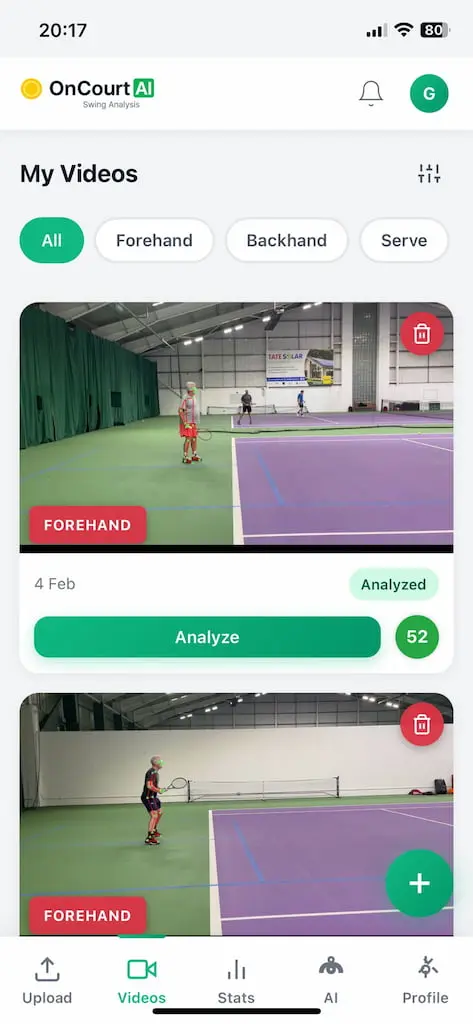
Your backhand style fundamentally changes the biomechanics. Our AI automatically identifies whether you use one or two hands by measuring wrist separation and hand activity at contact.
Detection Method:
At the contact frame, we measure the distance between your wrists. If your non-dominant hand is close to the racket (<25cm) and actively positioned above shoulder height, you're using a two-handed backhand. Otherwise, one-handed.
One-Handed Backhand
Detection Criteria:
- Wrist separation >25cm
- Non-dominant hand low/passive
- Greater shoulder rotation needed
Advantages: Greater reach, slice variation, elegant aesthetics
Challenges: Requires more strength, precision timing
Two-Handed Backhand
Detection Criteria:
- Wrist separation <25cm
- Non-dominant hand active
- Both hands on racket at contact
Advantages: More power, better topspin, easier learning curve
Challenges: Less reach, harder to slice
- Different Optimal Ranges: Two-handers can have less shoulder turn
- Power Source: One-handers rely more on shoulder rotation
- Contact Point: Two-handers can hit closer to body effectively
- Follow-Through: One-handers need more complete extension
Professional Examples: Roger Federer, Stan Wawrinka, and Dominic Thiem use one-handed backhands for variety and reach. Novak Djokovic, Rafael Nadal, and Andy Murray dominate with two-handed power and consistency.
Backhand preparation determines your power ceiling. Like the forehand, backhands benefit from shoulder-hip separation (X-factor), though the mechanics differ slightly.
Shoulder Rotation for Backhand:
On backhands, you turn your back to the net, creating shoulder rotation that loads trunk muscles. We measure the horizontal distance between shoulders to quantify this turn.
One-Handed: >22 cm shoulder turn (full unit turn essential)
Two-Handed: >18 cm shoulder turn (can be slightly less)
Excellent: >25 cm for both types (elite preparation)
Needs Work: <15 cm (insufficient coil)
Hip Rotation Measurement:
Your hips should turn less than shoulders, creating the X-factor stretch. We measure hip rotation separately and calculate the differential.
X-Factor on Backhand Side:
X-Factor = Shoulder Rotation - Hip Rotation
This measures elastic energy stored in your trunk. Backhand X-factor is typically 20-35cm - slightly less than forehand due to biomechanical constraints of the non-dominant side.
Excellent: >30 cm separation - professional level
Good: 20-30 cm separation - strong club player
Adequate: 15-20 cm separation - functional
Poor: <15 cm - rotating as single unit
- Elastic Loading: Shoulder turn stretches obliques and trunk muscles
- Early Preparation: Good turn allows more time for swing
- Power Reserve: Coil creates energy that releases through contact
- Balance: Proper turn maintains center of mass over base
- Consistency: Full preparation creates repeatable mechanics
Common Backhand Mistake: Failing to turn shoulders fully, especially on two-handers. This eliminates the power advantage of having two hands on the racket. Think "show your back" to the net on preparation.
Backhand contact point varies by style but principles remain constant. Our AI measures forward position, height, arm extension, and strike zone to optimize your contact location.
Forward Contact Position:
How far in front of your body you make contact, measured from shoulder to wrist. Contact point differs between one and two-handed backhands.
One-Handed Contact
Optimal: 25-40 cm (10-16") in front
Needs more forward contact for leverage and power generation with single arm.
Two-Handed Contact
Optimal: 15-30 cm (6-12") in front
Can hit slightly closer to body due to dual-arm power and control.
Contact Height Analysis:
We measure contact height relative to your shoulder and categorize into strike zones:
- High Zone: Shoulder to head (attacking position)
- Mid Zone: Waist to shoulder (comfort zone)
- Low Zone: Below waist (defensive slice or drive)
Arm Extension at Contact:
The angle formed by your shoulder, elbow, and wrist reveals leverage and control at impact.
One-Handed: 160-175° (nearly full extension for reach)
Two-Handed: 140-160° (slightly more bent is acceptable)
Over-Extended: >175° (locked arm, loss of control)
Too Bent: <130° (cramped, insufficient leverage)
- Direction Control: Forward contact enables crosscourt and down-the-line options
- Power Transfer: Proper position channels body weight into ball
- Spin Generation: Optimal height enables low-to-high brush
- Shot Consistency: Repeatable contact = repeatable results
- Court Position: Forward contact maintains offensive positioning
Head Stability Tracking:
We measure head position through contact. Professional players keep their head still and watch the ball onto the strings, even on backhands hit on the run.
Pro Tip: Two-handers can handle late balls better due to closer contact point. One-handers must set up earlier and make contact further forward to generate power.
Effective weight transfer separates powerful backhands from weak ones. Our AI tracks hip movement, balance, and stance to quantify your weight transfer efficiency.
Forward Hip Movement:
The horizontal distance your hips move from preparation through contact, measured in centimeters. This reveals how much body weight you're putting into the shot.
Excellent: >12 cm forward hip movement
Good: 6-12 cm forward movement
Minimal: 2-6 cm (some transfer)
Poor: <2 cm or backward (falling away from ball)
Balance Analysis:
We measure the offset between your center of mass and your base of support (midpoint between feet). Maintaining balance through the shot is critical for consistency.
Excellent: <15 cm offset (centered over base)
Good: 15-25 cm offset (stable)
Compromised: >25 cm offset (off-balance)
Stance Width Measurement:
The distance between your feet at different phases. Optimal width provides stability without restricting movement.
- Linear Momentum: Forward body motion adds mass x velocity to ball
- Ground Force: Pushing into court generates reactive upward force
- Stability Platform: Balanced transfer prevents mishits
- Recovery: Controlled transfer enables quick court coverage
- Shot Variety: Adjust transfer for offensive vs defensive shots
Open vs Closed Stance Backhands:
Our analysis adapts to your stance choice:
- Closed Stance: Forward step creates linear weight transfer
- Open Stance: Hip rotation creates angular momentum transfer
- Neutral Stance: Combination of step and rotation
Advanced Technique: Elite players often use open stance backhands for time-saving, especially two-handers. Our system measures whether you're generating sufficient hip rotation to compensate for lack of forward step.
Modern backhands require heavy topspin for consistency and court control. We analyze your racket path angle, swing plane, and brush distance to measure spin potential.
Racket Path Analysis:
The vertical angle of your racket path through the contact zone. We calculate the angle change from preparation to follow-through to determine low-to-high swing path.
Heavy Topspin: 25-45° upward path
Moderate Topspin: 15-25° upward path
Flat Drive: 5-15° upward path
Slice Backhand: 0° or negative (high to low)
Racket Angle at Contact:
The tilt of your racket face at impact, measured via forearm angle (proxy). Slightly closed face with upward path creates topspin while maintaining depth.
Brush Distance Measurement:
The vertical distance your racket travels through the ball. Longer brush distance = more spin potential when combined with racket head speed.
One-Handed Spin
Naturally generates more slice and underspin due to wrist freedom. Topspin requires aggressive low-to-high path (30-40°).
Two-Handed Spin
Generates more natural topspin due to dual-arm speed. Moderate path (20-30°) sufficient for heavy spin.
- Consistency: Topspin drops ball into court from high trajectory
- Margin for Error: Can hit harder with more safety
- Depth Control: Spin pushes ball deep in opponent's court
- High Bounce: Creates difficult balls above shoulder height
- Passing Shots: Topspin enables dipping passes by net rushers
Slice Backhand Detection: If our system detects a negative or flat racket path angle, it classifies the shot as a slice backhand and adjusts evaluation criteria accordingly. Slice requires different optimal ranges for power and control.
Complete follow-through ensures full power transfer and injury prevention. We measure follow-through distance, direction, and arm position at finish.
Follow-Through Distance:
The total distance your racket hand travels from contact to finish, measured in centimeters. Complete follow-through indicates full acceleration through contact.
One-Handed: 50-80 cm (20-32") - full extension needed
Two-Handed: 40-70 cm (16-28") - compact but complete
Short/Blocked: <30 cm - incomplete power transfer
Over-Hit: >90 cm - loss of control
Follow-Through Direction:
Where your racket finishes relative to your body. Optimal follow-through is forward and up, not across your body or behind your head.
Arm Position at Finish:
One-handers should finish with arm extended above opposite shoulder. Two-handers typically finish with hands at or above head height, wrapped around body.
- Energy Dissipation: Gradual deceleration prevents injury
- Power Confirmation: Complete follow-through proves full acceleration
- Balance Recovery: Controlled finish enables next shot preparation
- Muscle Memory: Consistent finish creates repeatable mechanics
- Shot Quality: Where you finish affects ball trajectory and spin
Recovery Position Analysis:
After completing follow-through, we track whether you return to athletic ready position. Elite players finish their backhand balanced and ready to move for the next ball.
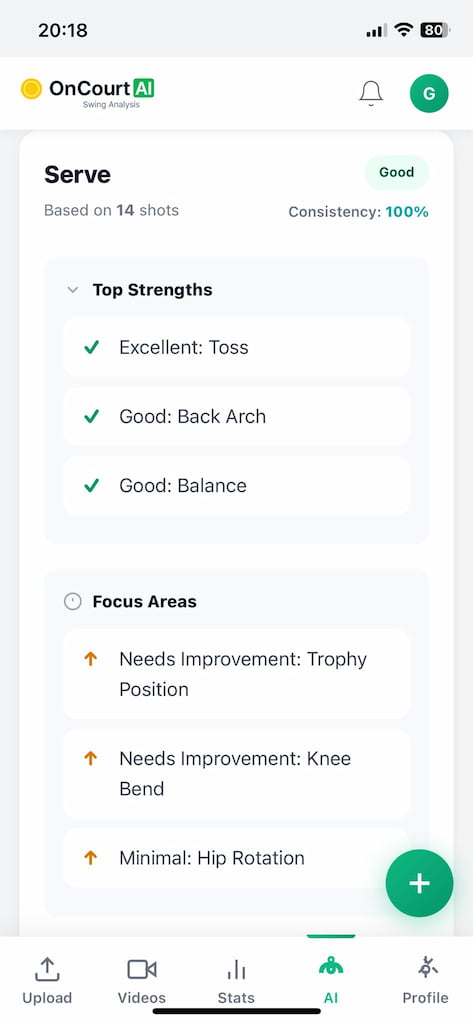
Your backhand receives detailed scoring across all components. The system adjusts expectations based on whether you use one or two hands.
Evaluated Components:
- Preparation: Shoulder turn, hip rotation, X-factor stretch
- Contact Point: Forward position, height, arm extension
- Weight Transfer: Hip movement, balance, stability
- Spin Generation: Racket path, brush distance, face angle
- Follow-Through: Distance, direction, completion
- Head Stability: Still head through contact
Personalized Coaching by Backhand Type:
One-Handed Recommendations:
- "Increase shoulder turn to 25+ cm for more power"
- "Make contact 30+ cm in front for better leverage"
- "Complete follow-through to 60+ cm extension"
- "Maintain arm extension 165-175° at contact"
Two-Handed Recommendations:
- "Improve shoulder turn despite having two hands"
- "Contact point can be 15-25 cm in front effectively"
- "Use non-dominant hand to generate more racket speed"
- "Focus on low-to-high path for natural topspin"
- Identify Weakest Component: Focus practice on lowest score
- Style-Specific Drills: Different emphasis for one vs two hands
- Progress Tracking: Re-analyze weekly to measure gains
- Video Study: Use frame-by-frame to understand mechanics
- Professional Comparison: Benchmark against ATP/WTA standards
Analyze Your Tennis Backhand
Get instant feedback on your one-handed or two-handed backhand technique. Discover exactly what's holding back your backhand power and consistency.
Start Backhand AnalysisBackhand Analysis FAQs
Should I switch from two-handed to one-handed backhand?
The decision depends on your goals and physical capabilities. Two-handed backhands are more powerful and consistent for most players. One-handed backhands offer greater reach and slice variety. Our analysis shows strengths of your current technique - major changes should be discussed with a pro coach.
Why is my backhand weaker than my forehand?
Common causes revealed by analysis: insufficient shoulder turn (<20cm), late contact point (behind body), poor weight transfer (<5cm), or incomplete follow-through. The AI identifies which specific component needs work.
Can AI analysis help with backhand slice technique?
Yes! The system detects slice backhands (negative racket path angle) and adjusts evaluation criteria. Slice requires different optimal ranges than topspin drives, which our analysis accounts for.
How do professional backhands compare to recreational players?
ATP/WTA players typically show: X-factor >30cm, contact 25-35cm forward, weight transfer >15cm, and consistent racket paths with 2000+ RPM topspin. Our analysis shows where you compare to these benchmarks.