Tennis Forehand Analysis Metrics Explained
Unlock the biomechanical secrets of powerful, consistent forehands. Learn how AI measures hip rotation, X-factor stretch, racket lag, and kinetic chain sequencing to help you hit like the pros.
Upload video, analyse every shot type, and track your improvement over time. Free for every player.
Discover OnCourtAI →
The X-factor stretch is your power source. This measurement reveals how much you're loading your trunk muscles with elastic energy before unleashing the forehand. Professional tennis players generate massive power through superior shoulder-hip separation.
Shoulder Rotation Analysis:
Shoulder Turn: The horizontal distance between your shoulders measures your upper body coil. This is measured in pixels and converted to centimeters and inches for real-world understanding.
Excellent shoulder turn
Full unit turn achieved
X-factor separation
Power storage zone
Elite level stretch
Professional standard
Hip Rotation Measurement:
The horizontal distance between your hips shows lower body preparation. Good hip turn (>15cm) creates a stable platform while maintaining the differential with shoulders that creates the X-factor.
X-Factor Separation:
The X-factor is the difference between shoulder and hip rotation. This measurement represents the torque stored in your trunk - the elastic energy that will explode through the ball at contact.
Excellent: >35 cm separation - elite power generation
Good: 25-35 cm separation - strong trunk loading
Adequate: 15-25 cm separation - room for improvement
Poor: <15 cm separation - rotating as one unit (limited power)
Shoulder & Hip Angles:
Beyond linear measurements, we calculate the actual angles of your shoulders and hips relative to the court. The difference between these angles confirms true trunk rotation rather than just turning your whole body.
- Elastic Energy Storage: Stretched muscles return energy like a rubber band
- Sequential Acceleration: Hips uncoil first, then shoulders whip through
- Racket Head Speed: Trunk rotation adds 20-30 mph to ball speed
- Injury Prevention: Proper loading distributes force across trunk muscles
- Professional Standard: ATP players average 40+ cm X-factor stretch
Common Forehand Technique Mistake: Recreational players often rotate shoulders and hips together as one unit, eliminating the X-factor and losing half their potential power. Think "shoulders turn twice as far as hips" for optimal separation.
Contact point determines everything - power, control, spin, and consistency. Our AI analyzes the exact position where racket meets ball, measuring forward distance, height, arm extension, and strike zone location.
Forward Contact Distance:
How far in front of your body you're making contact. This is measured from your shoulder to wrist at the contact frame, converted to centimeters for precise feedback.
Excellent: 20-40 cm (8-16") in front of shoulder
Good: 10-20 cm (4-8") in front
Late: <10 cm or behind shoulder line
Too Early: >40 cm (reaching, loss of control)
Contact Height Measurement:
Contact Height Zones: We measure contact height relative to your shoulder and classify it into optimal strike zones:
- High Zone: Shoulder to head level (offensive position)
- Mid Zone: Waist to shoulder (ideal control zone)
- Low Zone: Below waist (defensive position)
Arm Extension at Contact:
The angle formed by your shoulder, elbow, and wrist at contact reveals whether you're hitting with optimal leverage. We measure this angle and convert it to a quality rating.
Optimal extension
Power + control balance
Forward position
Contact out front
Strike height
Comfortable range
- Power Transfer: Forward contact transfers body weight into ball
- Ball Control: Consistent contact point = consistent shots
- Spin Generation: Proper height enables low-to-high brush
- Shot Variety: Different zones enable different shot types
- Court Coverage: Forward contact recovers court position faster
Head Position at Contact:
Our system tracks your head stability through contact, measuring the distance from your nose to the contact point. Professional players keep their head still and watch the ball onto the strings.
Pro Tennis Forehand Tip: Federer, Nadal, and Djokovic make contact 30-40cm in front of their body with rock-solid head position. This creates the perfect combination of power, control, and consistency.
Racket lag creates the whip effect that generates massive racket head speed. This advanced biomechanical metric separates recreational players from professionals.
What is Racket Lag?
Racket lag occurs when your hand leads the racket head through the forward swing. The racket trails behind (lags), storing energy in your wrist and forearm before snapping forward at contact. Our AI measures the angle between your forearm and wrist to quantify this lag.
Excellent: 30-50° of lag (wrist laid back significantly)
Good: 20-30° of lag (functional wrist position)
Minimal: 10-20° of lag (some benefit)
No Lag: <10° (pushing through contact, not whipping)
Wrist Snap Through Contact:
The angular velocity of your wrist as it releases through contact. This measurement captures the "snap" that accelerates the racket head from lag position to contact, adding significant speed to your forehand.
Lag Release Timing:
Our AI identifies when your wrist begins releasing from lag position. Optimal timing is 2-4 frames before contact - early enough to accelerate but late enough to maintain lag benefits.
- Elastic Energy: Lag stretches forearm flexor muscles like a spring
- Speed Multiplication: Lag doubles racket head speed at contact
- Effortless Power: Energy stored in lag releases automatically
- Spin Potential: Lag enables low-to-high racket path for topspin
- Pro Secret: ATP players maintain 40-50° lag through impact zone
Developing Racket Lag: Lag cannot be forced - it develops naturally from proper kinetic chain sequencing. Our analysis shows whether your body rotation is creating the conditions for natural lag to occur.
The kinetic chain is the secret to effortless power. Professional forehands aren't about arm strength - they're about perfect timing of body segments from ground up to racket.
Hip-Shoulder Separation Timing:
We measure when your hips begin rotating forward and when your shoulders follow. The time delay between these events reveals your kinetic chain efficiency.
Excellent: Hips lead shoulders by 40-80ms (0.04-0.08 seconds)
Good: Hips lead by 20-40ms
Adequate: Hips lead by 10-20ms
Poor: Simultaneous rotation or shoulders lead hips
Energy Transfer Sequence:
The optimal forehand sequence:
- Weight Transfer: Step forward, shift weight to front foot
- Hip Rotation: Hips explode open toward target
- Trunk Uncoiling: X-factor releases, shoulders follow hips
- Arm Acceleration: Shoulder rotation pulls arm forward
- Racket Lag Release: Wrist snaps, racket whips through
Deceleration Timing:
After contact, segments decelerate in reverse order. We measure follow-through completion to ensure proper energy dissipation, which prevents injury and enables recovery position.
- Summation of Forces: Each segment accelerates the next
- Energy Amplification: Ground force multiplies through chain
- Efficient Mechanics: No wasted motion or energy leaks
- Injury Prevention: Proper sequence distributes stress
- Consistency: Timing groove creates repeatable mechanics
Common Kinetic Chain Fault: "Arm-only" forehands where shoulders and hips rotate together or arms move first. This creates 40% less racket speed and high injury risk. Our analysis reveals these timing breakdowns.
Modern tennis requires heavy topspin for consistency and court control. Our AI analyzes your racket path and swing plane to quantify spin generation potential.
Racket Path Angle:
The vertical angle of your racket path through contact. We measure the difference between your racket position before and after contact to determine the low-to-high swing path critical for topspin.
Heavy Topspin: 30-50° upward path (Nadal-style)
Moderate Topspin: 15-30° upward path (control forehand)
Flat Drive: 0-15° upward path (penetrating shot)
Slice/Chop: Negative angle (high to low)
Racket Angle at Contact:
The tilt of your racket face at impact. We measure the angle of your forearm (proxy for racket) relative to vertical. Slight forward tilt creates topspin while maintaining depth.
Brush Distance:
The vertical distance your racket travels through the contact zone. Longer brush = more spin potential. Professional players brush 40-60cm through the ball on topspin forehands.
Low-to-high path
Topspin angle
Brush distance
Spin generation
Pro topspin
Modern forehand
- Net Clearance: Spin drops ball into court from high trajectory
- Margin for Error: Can swing faster with more spin for safety
- Ball Depth: Heavy spin kicks deep in opponent's court
- High Bounce: Topspin creates difficult high balls
- Modern Game: ATP players average 2500+ RPM on forehands
Topspin Development: Spin isn't created by "rolling" your wrist - it comes from an aggressive low-to-high swing path with a slightly closed racket face. Our analysis shows whether your mechanics enable natural spin generation.
Power comes from the ground up through proper weight transfer. Our AI tracks your center of mass movement and balance throughout the forehand motion.
Forward Weight Transfer:
The horizontal movement of your hips from preparation through contact, measured in centimeters. This quantifies how much you're transferring weight forward into the ball.
Excellent: >15 cm forward hip movement
Good: 8-15 cm forward movement
Minimal: 3-8 cm (some transfer)
Neutral/Backward: <3 cm or negative (falling away from ball)
Balance at Contact:
We measure the offset between your center of mass (approximated by nose position) and your base of support (midpoint between ankles). Good balance keeps this offset minimal.
Stance Width Analysis:
The distance between your feet at key moments (preparation, contact, finish). Optimal stance width provides stability while allowing dynamic movement.
- Ground Force Reaction: Pushing into ground creates upward/forward force
- Momentum Transfer: Body mass moving forward adds ball speed
- Stable Platform: Balanced transfer prevents mishits
- Recovery Position: Forward movement puts you in court
- Shot Variety: Control weight transfer for different shots
Recovery Position:
After follow-through, we track whether you return to athletic ready position. Elite players complete their forehand with weight on their front foot, ready to move in any direction for the next shot.
Open Stance vs Closed Stance: Our analysis works for both. Open stance uses more hip rotation for weight transfer, while closed stance uses forward stepping. Both can be effective with proper mechanics.
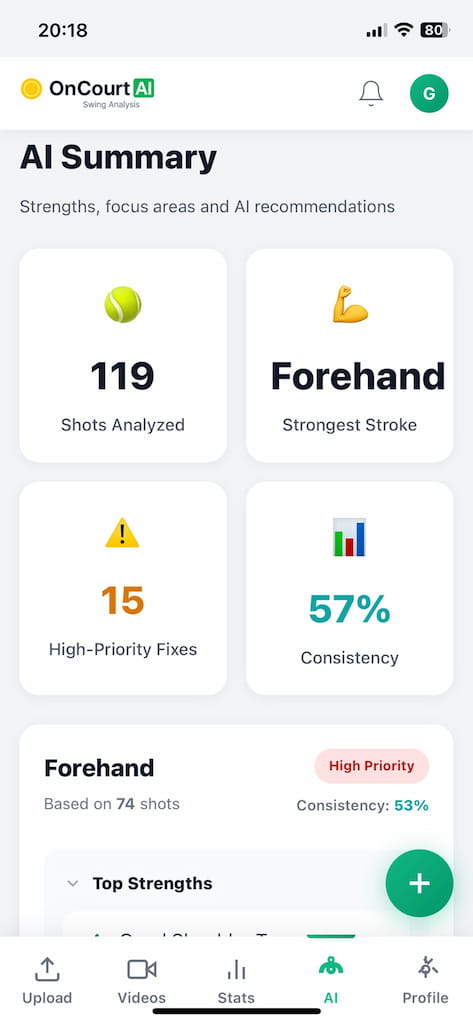
Your forehand receives a detailed score across all biomechanical components. Each element is evaluated independently and combined for an overall technique rating.
Scored Components:
Preparation
X-factor, shoulder turn, unit turn
Contact Point
Forward position, height, extension
Swing Path
Racket lag, acceleration, brush
Kinetic Chain
Hip-shoulder timing, sequence
Spin Generation
Racket path, angle, brush
Balance
Weight transfer, stability, recovery
AI-Generated Coaching Recommendations:
Based on your scores, receive specific, prioritized improvements:
- "Increase X-factor stretch to 30+ cm for more power"
- "Make contact 20-30 cm further forward"
- "Develop racket lag by letting body rotation pull arm"
- "Improve hip-shoulder separation timing - hips first"
- "Increase low-to-high swing path for heavier topspin"
- "Transfer more weight forward (15+ cm hip movement)"
- Identify Weak Links: Focus on lowest-scoring component first
- Track Progress: Re-test weekly to measure improvements
- Video Comparison: Study frame-by-frame analysis of your stroke
- Pattern Recognition: Notice trends across multiple analyses
- Professional Benchmarks: Compare your metrics to ATP standards
Analyze Your Tennis Forehand Today
Get instant biomechanical feedback on your forehand technique. Upload a video and discover exactly what's limiting your power and consistency.
Start Forehand AnalysisTennis Forehand Analysis FAQs
What's the most important metric for forehand power?
X-factor stretch (shoulder-hip separation) is the #1 power predictor. Studies show that increasing X-factor from 20cm to 35cm can add 15-20 mph to your forehand speed. Focus here first for maximum improvement.
How does AI measure racket lag?
We track the angle between your forearm and wrist through the forward swing. Since rackets extend from wrists, forearm-wrist angle reveals racket lag. This proxy measurement is validated against high-speed camera studies.
Can beginners benefit from forehand analysis?
Absolutely! While the metrics may seem advanced, the system generates beginner-friendly recommendations. Focus on the top 2-3 suggestions and ignore complex measurements until your technique matures.
How do I improve my kinetic chain timing?
Practice "hips first" drills. Start your forward swing by rotating hips while keeping shoulders back momentarily. This creates the lag that allows proper sequencing. Our analysis shows whether you're achieving this timing.