Tennis Serve Analysis Metrics Explained
Upload video, analyse every shot type, and track your improvement over time. Free for every player.
Discover OnCourtAI →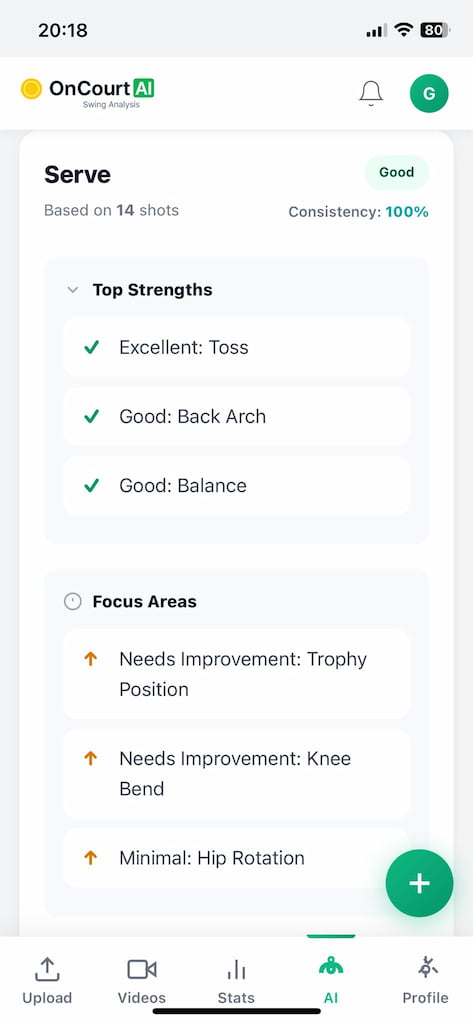
The ball toss is the foundation of every great tennis serve. Our AI analyzes your toss height, placement, and consistency to identify the optimal ball position for maximum serve power and accuracy.
What We Measure:
Toss Height: The vertical distance between your shoulder and the ball at its peak. Measured in pixels and converted to centimeters for real-world accuracy.
Excellent: >200 pixels (~45+ cm)
Good: 150-200 pixels (~35-45 cm)
Needs Improvement: <150 pixels (<35 cm)
Toss Frame Detection:
Our system identifies the exact frame where your toss hand reaches its highest point, typically occurring in the first half of the serve motion. This helps analyze the timing and coordination between your toss and racket preparation.
- Power Generation: A higher toss allows more time to build racket head speed
- Contact Point Consistency: Consistent toss height leads to more reliable contact
- Serve Trajectory: Proper height enables hitting up and through the ball
- Timing Rhythm: Good toss height establishes proper serve tempo
Common Tennis Serve Toss Faults: Tossing too low forces rushed swing mechanics and reduces serve power. Tossing too far forward or backward causes off-balance serves and inconsistent ball placement.
The trophy position is where you store elastic energy before exploding into the ball. This critical serve phase determines your power potential and injury risk. Our AI measures racket drop depth and elbow positioning for optimal serve mechanics.
Racket Drop Measurement:
Racket Drop: The vertical distance between your elbow and wrist at the trophy position. This measures how far the racket head drops behind your back, creating the "scratch your back" position that professional tennis players use to generate massive serve speed.
Excellent: Racket drop <-50 pixels (elbow significantly above wrist) + elbow angle >90°
Good: Racket drop <-20 pixels with reasonable shoulder rotation
Needs Improvement: Minimal racket drop or poor elbow position
Elbow Angle at Trophy:
The angle formed by your wrist, elbow, and shoulder at the trophy position indicates proper shoulder external rotation - a key biomechanical factor in generating serve speed while protecting your shoulder from injury.
Optimal elbow angle for power and safety
Excellent racket drop creates whip effect
- Elastic Energy Storage: Deep racket drop loads shoulder muscles like a spring
- Longer Acceleration Path: More distance to build racket head speed
- Kinetic Chain Efficiency: Proper position enables energy transfer from legs to racket
- Injury Prevention: Correct mechanics reduce shoulder and elbow stress
Professional Tennis Serve Technique: ATP and WTA pros achieve racket drops of 50+ pixels, creating the characteristic "bow and arrow" position that generates 120+ mph serve speeds.
Your legs generate 50% of your serve power. Our AI measures knee bend angle at the trophy position to ensure you're using leg drive effectively in your tennis serve motion.
Knee Angle Measurement:
The angle formed by your hip, knee, and ankle at the trophy position. This measurement reveals whether you're loading your legs properly to drive upward into the ball.
Excellent: 130-150° (ideal power position)
Good: 120-160° (functional range)
Needs Improvement: <120° (too bent) or >160° (insufficient bend)
Why This Specific Range:
130-150 degrees represents the sweet spot where your quadriceps muscles can generate maximum upward force without compromising balance. Too bent (smaller angle) causes instability, while too straight (larger angle) fails to utilize leg power.
- Ground Force Reaction: Proper knee bend allows powerful upward push
- Energy Transfer: Legs initiate the kinetic chain that ends at racket
- Upward Trajectory: Leg drive enables hitting up through the ball
- Serve Speed: Leg contribution adds 20-30 mph to serve velocity
Common Mistake: Recreational players often serve with straight legs (>160°), eliminating half their potential serve power. Professional tennis players consistently achieve 130-150° knee bend, driving up explosively through the ball.
The contact point determines serve placement, power, and spin. Our AI analyzes contact height, arm extension, and timing to optimize your impact position.
Contact Height Measurement:
Contact Height: Vertical distance from your nose to your wrist at contact. This indicates how high you're reaching at impact - critical for serve angle and clearance over the net.
Excellent: Extension >100 pixels (wrist significantly above shoulder) AND height >150 pixels
Good: Extension >50 pixels with reasonable contact height
Needs Improvement: Low extension or low contact point
Arm Extension at Contact:
The vertical distance between your shoulder and wrist at contact. Maximum extension creates the longest possible lever arm, generating greater racket head speed and allowing steeper serve angles into the service box.
Arm extension for maximum reach
High contact point creates angle
- Service Box Angle: Higher contact allows steeper downward angle
- Net Clearance: More margin for error over the net
- Power Generation: Full extension maximizes racket speed
- Serve Variety: High contact enables topspin and slice serves
Pro Tip: Professional tennis players make contact 2-3 feet above their head, creating severe downward angles that recreational players can't replicate with lower contact points.
Track your serve speed progress with AI-powered velocity measurement. Our system estimates serve speed by analyzing racket head velocity at contact, helping you understand how technique changes affect your serve power.
How We Calculate Serve Speed:
Our AI tracks your wrist movement (proxy for racket head) through a window around the contact point, measuring maximum velocity. This velocity is converted to miles per hour using calibrated biomechanical multipliers.
Professional Level: 100+ mph (ATP: 120-140 mph, WTA: 90-110 mph)
Advanced Club Player: 80-100 mph
Intermediate Player: 60-80 mph
Beginner: 40-60 mph
Confidence Level:
The system reports confidence based on the number of velocity samples captured:
- High Confidence: 5+ samples (excellent tracking through contact)
- Medium Confidence: 2-4 samples (acceptable measurement)
- Low Confidence: <2 samples (estimate may be less accurate)
- Technique Over Force: Good mechanics add more speed than muscle
- Progressive Improvement: 5-10 mph gains come from fixing one element
- Consistency Matters: Repeatable 85 mph beats erratic 95 mph
- Speed + Placement: Combine velocity with accuracy for winning serves
Important Note: Serve speed estimates are calibrated but may vary based on video quality and camera angle. For exact speeds, use radar guns. This metric is most valuable for tracking relative improvements in your serve technique over time.
Your serve receives a comprehensive score based on all biomechanical components. Each element is weighted equally, and the system generates personalized coaching recommendations.
Component Scoring System:
Excellent
Professional-level technique
Good
Solid fundamentals
Needs Work
Room for improvement
What Gets Scored:
- Ball Toss: Height, consistency, placement
- Trophy Position: Racket drop, shoulder rotation
- Knee Bend: Leg drive, power generation
- Contact Point: Height, extension, timing
Personalized Tennis Serve Coaching:
Based on your scores, the AI generates specific, actionable recommendations:
- "Work on toss consistency - aim for 1-2 feet above contact point"
- "Increase racket drop behind back for more power"
- "Bend knees more (130-150°) to generate leg drive"
- "Reach up higher at contact point for better trajectory"
- Focus on Weakest Element: Biggest gains come from fixing your lowest-scoring component
- Track Progress: Re-analyze weekly to measure improvement
- One Change at a Time: Master each element before combining
- Video Reference: Compare your form to the frame-by-frame analysis
Frequently Asked Questions
How accurate is AI tennis serve analysis?
Our AI uses MediaPipe pose detection, trusted by sports scientists. While exact speeds vary, relative improvements are highly reliable for identifying serve mechanics and progress.
What video quality do I need for serve analysis?
Standard smartphone video (720p or better) from a side view works best. Ensure your full body is visible throughout the serve motion for optimal tracking accuracy.
Can I improve my serve speed using these metrics?
Yes. Studies show that improving toss consistency, trophy position, and knee bend can add 15–30 mph to your serve speed.
How often should I analyze my tennis serve?
Weekly analysis during active serve development provides the best feedback loop. Once your technique stabilizes, monthly check-ins help maintain consistency and catch regression early.
How do I fix my toss consistency?
Our AI tracks toss height and placement. Aim for 30–50 cm above your contact point for optimal power and accuracy.
What is the optimal knee bend for a tennis serve?
The ideal knee bend is between 130–150 degrees. This range maximizes leg drive and upward force without compromising balance.
How high should my contact point be?
Professional players make contact 22–35 cm above their head. A higher contact point improves trajectory, spin, and net clearance.
What is the role of hip and shoulder rotation in serve power?
Hip and shoulder rotation generate core torque. Optimal rotation (60–100 degrees) transfers energy through the kinetic chain, adding speed and reducing injury risk.
Can AI coaching help prevent tennis injuries?
Yes. By monitoring elbow angles, shoulder rotation, and balance, AI highlights risky mechanics and provides recommendations to reduce strain on joints.
Do I need a coach if I use AI serve analysis?
AI analysis provides objective data and recommendations, but combining it with a coach’s guidance ensures faster improvement and personalized training.