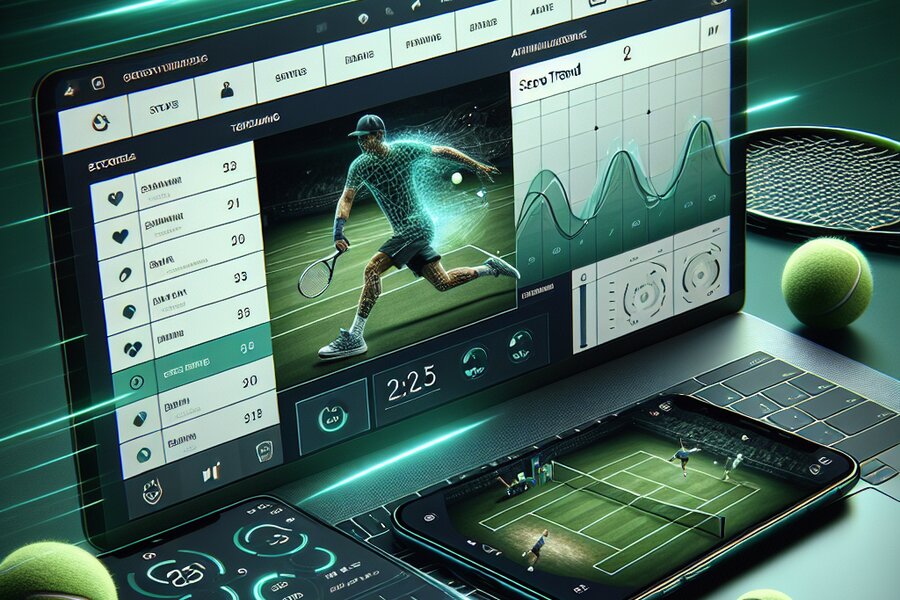
When we built OnCourtAI, the goal was always to give every tennis player access to the kind of biomechanical insight that was previously only available to professionals. We have been building towards that goal since day one — and in 2026, the platform has taken its most significant leap forward yet. This post walks through the four major updates we have shipped and explains what each one means for your game.
Shot-by-Shot Analysis
The original OnCourtAI experience gave you an analysis of your session as a whole. You would upload a video, the AI would process it, and you would receive an overall technique score, a breakdown of your key biomechanical metrics and a list of the most significant issues to address. That was — and still is — enormously useful. But it left a question unanswered: which specific shot was the problem?
Shot-by-shot analysis answers that question directly. When you upload a session now, the AI segments the video into individual shots and provides a separate analysis for each one. Every forehand, every backhand, every serve and every volley in your session gets its own score, its own biomechanical breakdown and its own coaching note.
The practical value of this is significant. If your forehand score is 72 overall but shot 1 and shot 3 both scored 45, that tells you something specific: those two shots had a particular fault that the others did not. You can immediately watch those two shots, compare them to your higher-scoring forehands and identify exactly what went wrong — whether it was footwork, preparation time, contact point or follow-through. That level of specificity was simply not possible before.
Shot-by-shot analysis is available on all session types and is included as standard for all OnCourtAI users.
Frame-by-Frame Video Analysis
Video analysis has always been part of OnCourtAI, but we have now made it dramatically more detailed with the introduction of frame-by-frame review. You can now scrub through any uploaded video one frame at a time.
This means you can stop at the exact moment of ball contact and see precisely where your racket face is pointing, what your elbow position is and where your weight is distributed. You can step back three frames and see how your hip rotation initiated the swing. You can step forward two frames and see how quickly your arm is decelerating after contact.
Professional biomechanics analysis has always worked this way — frame by frame, with trained analysts reviewing each moment of a stroke. What we have done is make that level of granularity available to every player, on any device, for any session they upload. The frame-by-frame viewer is available on the mobile app, and works with any video quality from a standard smartphone recording upwards.
When you combine frame-by-frame review with shot-by-shot analysis, the workflow becomes very powerful. Find the shot that scored lowest, open the frame-by-frame viewer for that specific shot, and work through it moment by moment until you find the exact frame where the technique breaks down. That frame is your coaching focus for the next session.
Slow-Motion Analysis
A tennis stroke at full speed is over in less than half a second from backswing to follow-through. The human eye simply cannot process everything that happens in that time. Slow-motion video has long been a staple of professional coaching for exactly this reason — but accessing it has traditionally required either expensive high-frame-rate camera equipment or a production team with time to process footage manually.
OnCourtAI now generates slow-motion analysis automatically from any uploaded video, regardless of the camera used to record it. Our AI upsamples the frame rate of your video using motion estimation technology, creating a smooth slow-motion sequence that can be played back at 0.25x speed without the jerkiness that comes from simply stretching the existing frames.
The difference in what becomes visible at 0.25x is substantial. At full speed, a flawed serve might just look slightly off. In slow motion, you can clearly see if the ball toss is drifting forward, if the shoulder turn is incomplete before the racket accelerates, or if the wrist is rolling over at contact rather than driving through the ball. These are the details that change everything — and they are now visible to every OnCourtAI user on every session they upload.
Improved AI Model Accuracy
Every feature we ship is only as good as the accuracy of the AI model underlying it. In 2026, we have made the most significant improvements to our core model since launch — and the results are measurable.
The updated model processes 30,000 data points per 30-second video, tracking 27 key biomechanical markers across the full kinematic chain from feet to racket tip. The improvements this year focused on three specific areas.
First, we significantly reduced false positives on technique fault detection. The previous model would occasionally flag a biomechanical deviation as a fault when it was actually a deliberate stylistic choice or a natural variation within normal range. The updated model is far better at distinguishing genuine faults from natural variation, which means the coaching feedback you receive is more precise and less noisy.
Second, we improved tracking accuracy in challenging conditions — particularly low-contrast backgrounds, partial occlusion (where the racket or another player passes in front of a body part) and video captured in poor lighting. These are real-world conditions that club players frequently encounter, and the model now handles them substantially better.
Third, we improved the accuracy of our stroke detection algorithm — the part of the model that identifies where one shot ends and the next begins within a continuous video. This is foundational to shot-by-shot analysis, so getting it right was a prerequisite for shipping that feature. The current stroke detection accuracy is 97.3% across our validation set of 8,400 labelled shots across all major stroke types.
What's Coming Next
We are not stopping here. The development roadmap for the rest of 2026 includes real-time session feedback (reducing the gap between upload and analysis to under 20 seconds), expanded stroke type coverage to include dropshots and lobs, and deeper tactical pattern analysis that goes beyond individual strokes to look at shot selection patterns across a full match.
If you have not tried OnCourtAI yet, or if you have not used it since last year, now is the time. Upload your first session at oncourtai.co.uk/mobile-app and experience the updated platform for yourself.