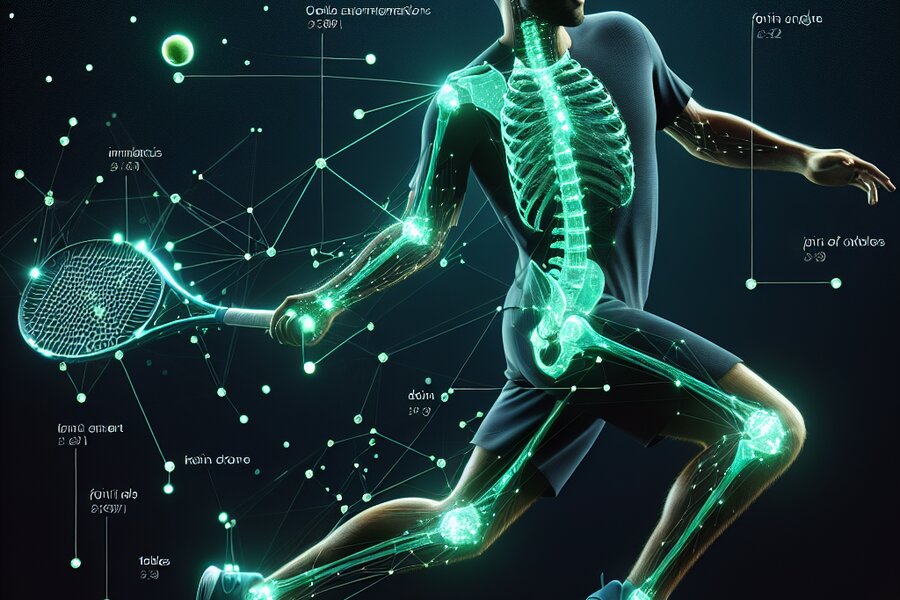
2026 has been a landmark year for artificial intelligence in tennis — not just at the professional level, where AI-powered performance analytics have been a fixture for years, but increasingly in the hands of club players and amateur coaches who have never before had access to anything like this technology. The convergence of advances in computer vision, mobile processing power and cloud AI infrastructure has, in the space of about 18 months, fundamentally changed what is possible for any player with a smartphone. Here is what has changed, why it matters and how OnCourtAI is at the leading edge of it.
The Biomechanical Analysis Breakthrough
Until relatively recently, meaningful biomechanical analysis of a tennis stroke required a specialist facility, expensive marker-based motion capture equipment and a trained analyst to interpret the output. The data was accurate and detailed, but access was effectively restricted to elite players whose clubs or national federations could fund the infrastructure.
The breakthrough that changed everything was markerless motion capture via consumer video. Advances in pose estimation AI — the technology that identifies and tracks body landmarks from video frames — reached a level of accuracy in 2024 and 2025 that made it viable for sports performance analysis for the first time. The models can now reliably identify 27 or more key biomechanical markers — joint positions, limb orientations, centre of mass — from a standard smartphone video, without any specialist equipment, calibration targets or controlled lighting.
What this means in practice is that the kind of kinematic chain analysis that was once the exclusive domain of elite sport science — tracking how force travels from the ground through the feet, hips, torso, shoulder, elbow, wrist and racket in sequence — is now available to any player who films their session on their phone. The hardware barrier has effectively disappeared. The only thing that determines the quality of the analysis is the sophistication of the AI model processing the video.
OnCourtAI's model processes 30,000 data points per 30-second video across 27 key biomechanical markers. This is not a marketing number — it reflects the genuine density of measurement that the model performs at each frame of the video, tracking position, velocity and acceleration vectors for every tracked landmark simultaneously. The result is a richly detailed picture of your stroke mechanics that no human coach could manually extract from watching the same footage.
Real-Time Feedback Technology
The next frontier in tennis AI is closing the gap between when a shot is hit and when the player receives feedback on it. For most of the history of video analysis, that gap was measured in hours or days — you recorded a session, sent the footage somewhere, waited for it to be processed and reviewed the results later. More recently, cloud AI has compressed that gap to minutes. OnCourtAI currently delivers full session analysis — including shot-by-shot breakdown, frame-by-frame annotation and slow-motion generation — within minutes of an upload completing.
The direction of travel in the industry is clear: the goal is analysis that is effectively simultaneous with the shot, delivered as the player is still standing at the baseline. This requires AI processing pipelines that operate at or near real-time speeds on mobile hardware — a significant technical challenge, but one that the rapid improvement in mobile GPU capability is steadily making more tractable.
The implications for coaching are profound. A player who receives feedback on their serve within 30 seconds of hitting it — while they are still feeling the mechanics of the stroke in their body — can adjust and immediately compare. The learning loop tightens dramatically. We are not there yet, but 2026 has brought that capability meaningfully closer, and it is an explicit target on the OnCourtAI development roadmap.
What 30,000 Data Points Actually Means
The phrase "30,000 data points per video" appears frequently in discussions of OnCourtAI, but it is worth being specific about what it actually means — because the meaning is what makes it powerful.
A 30-second video at 30 frames per second contains 900 frames. At each frame, the AI is tracking 27 body landmarks. For each landmark, it is measuring position in three dimensions (x, y, z coordinates), velocity (how fast the landmark is moving), acceleration (whether it is speeding up or slowing down) and angular relationships with adjacent landmarks (joint angles). That is approximately 10 to 12 data measurements per landmark per frame — multiplied by 27 landmarks and 900 frames, you arrive at a number in the range of 250,000 to 300,000 individual measurements. The 30,000 figure refers specifically to the key performance-relevant metrics extracted from this larger raw dataset — the measurements that are actually meaningful for coaching purposes after the noise is filtered out.
The significance of this volume of data is that it enables pattern recognition that no human observer could perform manually. A coach watching video might notice that a player's contact point is occasionally too far in front of their body on the forehand. The AI, tracking 30,000 relevant metrics, can tell you not just that this happens, but in what proportion of forehand shots it occurs, how it correlates with the player's hip rotation speed, whether it is more likely to occur on the forehand to the deuce side than the ad side, and whether it has been improving or worsening over the past ten sessions.
That depth of pattern recognition is what turns raw data into actionable coaching insight. Volume alone is not the point — but volume enables the kind of statistical reliability and correlation analysis that makes the coaching output genuinely useful rather than anecdotal.
How OnCourtAI Compares to the Alternatives
To understand where OnCourtAI sits in the landscape of tennis performance technology, it helps to look at the alternatives and what they can and cannot do.
Basic slow-motion apps capture video at high frame rates and play it back in slow motion. They are useful for a rough visual inspection but provide no data, no measurements and no AI analysis. The coach or player has to interpret everything they see manually, which requires both expertise and a significant time investment. They cannot identify patterns across multiple sessions or compare performance against benchmarks.
Wearable sensors — accelerometers and gyroscopes attached to the racket or wrist — can measure swing speed, racket orientation and impact characteristics. They are useful for tracking training volume and comparing serve speeds, but they measure a single point in the kinematic chain in isolation. They cannot analyse whole-body mechanics, cannot see footwork patterns and cannot assess technique from a holistic perspective. They are also expensive and require additional hardware beyond a smartphone.
Professional motion capture laboratories represent the gold standard of biomechanical analysis, with marker-based systems capable of sub-millimetre tracking accuracy across every joint simultaneously. They are also prohibitively expensive, require controlled environments, need trained operators and are inaccessible to the vast majority of players. Many elite national training centres do not have one.
OnCourtAI occupies a unique position: whole-body biomechanical analysis, from any smartphone video, with AI model accuracy that approaches what was previously only available in specialist facilities, delivered within minutes, free of charge. It is not yet at motion capture laboratory accuracy — no markerless system is — but it is accurate enough to identify the technique faults that actually limit a club player's development, and it is accessible to everyone.
What the Science Says
The academic research on tennis biomechanics has been building for decades, and the findings are consistent: the kinematic chain sequencing of a tennis stroke — the precise timing and amplitude of rotations from the ground upwards — is the single most important determinant of both power output and injury risk in the serve and groundstrokes.
Studies published in the Journal of Sports Sciences and the British Journal of Sports Medicine have shown that even small deviations in the timing of hip and shoulder rotation can reduce serve speed by 8-12 mph and significantly increase loading on the shoulder and elbow. These are exactly the deviations that AI biomechanical analysis can detect and quantify — and that the eye of even a skilled coach can easily miss at full video speed.
The implication for everyday coaching is that the most important things to fix in a player's stroke mechanics are often invisible without detailed frame-by-frame analysis. A player who appears to have a technically sound serve but is losing 10 mph to a sequencing fault may never discover the issue without the kind of data that AI analysis provides.
The Impact for Club Players
The aggregate effect of these advances on club player development is already becoming measurable on the OnCourtAI platform. Players who engage consistently with the AI analysis — uploading sessions regularly, reviewing their frame-by-frame breakdowns and acting on the coaching notes — are showing significantly faster technique improvement than the broader player population.
Average technique score improvements of 28-35% over a consistent 12-week engagement period have been recorded across the platform's most active users. Serve speed gains of 8-15 mph are common among players who use the slow-motion analysis to identify and correct sequencing faults. And there is an emerging picture of injury prevention benefit: players who correct the biomechanical issues flagged by the AI report fewer overuse injuries in the shoulder and elbow — the most common tennis injuries — in the months following the correction.
These are the outcomes that the biomechanical analysis breakthrough makes possible for players who previously had no access to this level of insight. It is genuinely democratising — and it is only going to get better from here. Upload your first session at oncourtai.co.uk/mobile-app and see what 30,000 data points can tell you about your game.