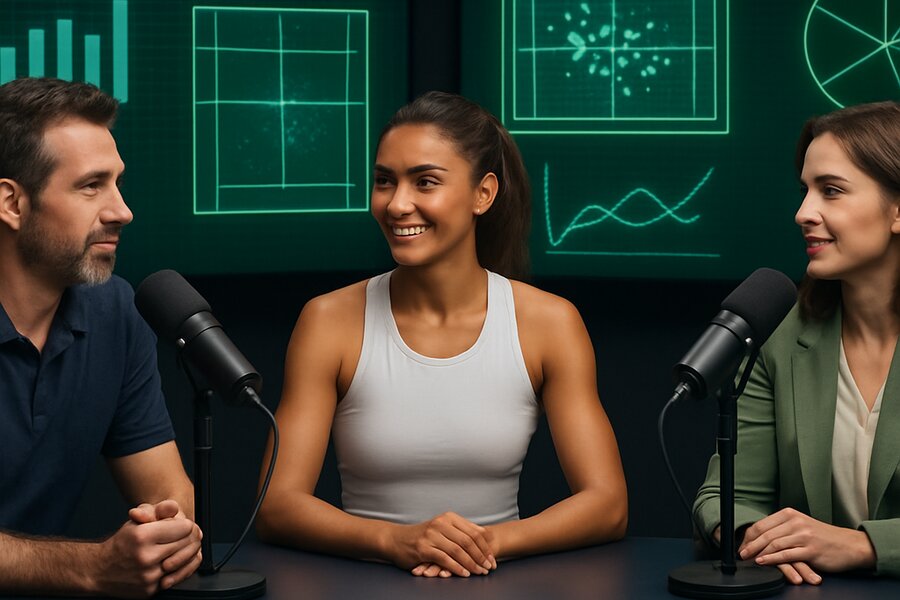
When we first told people we were building an AI-generated tennis podcast, the most common reaction was scepticism. Podcasts are personal. They are driven by personality, expertise and the kind of unscripted chemistry that makes you feel like you are listening in on a conversation between people who genuinely know and care about the subject. Could an AI really replicate that?
As we dive into the 3rd month, Court Report by OnCourtAI has answered that question emphatically. The podcast has become one of the most listened-to features on the platform, with players telling us it has become part of their weekly routine — listened to on the drive to training, during warm-up, or while cooling down after a session. This article goes behind the scenes to explain how it works, who the hosts are, and why the format produces something genuinely different from any other tennis content available.
The Data Pipeline
Every episode of Court Report starts with data. Not curated talking points. Not a producer's editorial calendar. Actual performance data from real players who uploaded sessions to OnCourtAI during the previous week.
Each week, the platform aggregates anonymised biomechanical data from every session uploaded during that period. This includes stroke-by-stroke metrics across all major stroke types — forehands, backhands, serves and volleys — along with technique scores, common fault patterns, improvement trends and any statistical outliers that the system identifies as noteworthy.
The core data is completely anonymised. What remains is the collective story of what happened on tennis courts around the world that week: which strokes players worked on most, where the biggest technique challenges appeared, what improved across the player base, and what the numbers suggest about common patterns in how club players develop their games.
This data forms the raw material for the episode script. An AI script generation system analyses the aggregated data and identifies the two or three most interesting, useful or surprising patterns — the topics that will give listeners the most actionable value.
Meet the Hosts
Court Report has three permanent hosts, each with a distinct voice, personality and area of expertise. They are AI-generated characters, but they are consistent, recognisable and — according to listener feedback — genuinely enjoyable to listen to.
Coach Chris — Head Coach
Coach Chris is the heart of the show. He is a warm, practical ex-club coach with decades of experience helping players of all levels. His role on Court Report is to translate the week's data into concrete, actionable coaching advice. When the data shows that 60% of forehands uploaded this week had a late backswing, Coach Chris does not just report the statistic — he explains what causes a late backswing, what it does to the rest of the stroke, and gives you a specific drill to fix it before your next session.
Coach Chris's strength is his ability to make complex biomechanical information feel accessible and immediately useful. He talks the way a good club coach talks: directly, with genuine enthusiasm for helping players improve, and with an instinct for the one specific thing you should focus on rather than overwhelming you with information.
Alex — Former WTA Professional
Alex is a former touring professional who competed on the WTA circuit. She brings the competitive perspective that Coach Chris's club coaching experience naturally complements. When the data shows a particular pattern among club players, Alex explains how that same pattern manifests at the professional level — and what the differences reveal about the gap between recreational and competitive tennis.
Alex's contributions are particularly valuable when the data involves serve mechanics, tactical shot selection, or the kind of pressure-induced technique breakdown that is invisible in practice but devastating in matches. She has lived those moments on tour and brings an authenticity to the discussion that makes abstract data feel real and relevant.
Dr Sam — Sports Psychologist
Dr Sam is a sports psychologist specialising in racquet sports performance. Her role on Court Report is to add the dimension that most tennis coaching content ignores entirely: the psychological side. When the data shows that players' technique scores drop on their second serve compared to their first, Dr Sam explains the anxiety mechanism behind that pattern, the confidence loop that sustains it, and the mental techniques that break it.
Dr Sam is the host that listeners most frequently tell us they did not expect to enjoy but now consider essential. Her insights connect the biomechanical data to the lived experience of playing tennis under pressure, and her practical exercises for building mental resilience are some of the most shared content from the podcast.
How Episodes Are Structured
Each episode follows a consistent format that listeners can rely on, while the content changes completely every week because it is driven by fresh data.
The episode opens with a brief overview of the week's data: how many sessions were uploaded, which stroke types dominated, and whether the overall trend across the player base was improvement, regression or stability. This takes about 90 seconds and gives listeners immediate context for what follows.
The main segment is a 6-8 minute deep dive into the week's most significant coaching topic. All three hosts contribute, with Coach Chris leading the technique discussion, Alex adding the competitive context, and Dr Sam covering the psychological angle. The conversation flows naturally between them — disagreeing, building on each other's points, and occasionally surprising each other with an insight that changes the direction of the discussion.
The episode closes with a "take it to court" segment — a specific drill, focus point or mental exercise that listeners can use in their very next session. This is always directly connected to the episode's main topic, so every episode leaves listeners with something concrete and actionable.
Total runtime is typically 8-10 minutes — long enough to deliver genuine value, short enough to fit into a warm-up, cooldown or commute.
Why Real Data Makes It Different
The fundamental difference between Court Report and every other tennis podcast is that Court Report is reactive to what is actually happening. It does not rely on a producer deciding what topics might be interesting. It does not recycle the same technique tips that have been circulating in coaching circles for decades. It responds to the real, current, measurable patterns in how players are actually hitting the ball this week.
This means the podcast is genuinely seasonal in a way that reflects real playing conditions. When the data shows that technique scores across the board dipped during the first cold week of autumn — and specifically that shoulder rotation reduced and swing paths shortened — Court Report discussed why cold weather affects biomechanics and what players can do to counteract it. No editorial team would have thought to cover that topic at that specific moment. The data made it obvious.
It also means that if you are an OnCourtAI user, your data is part of the conversation. Your sessions, aggregated with thousands of others, contribute to the patterns that Coach Chris, Alex and Dr Sam discuss every week. There is a uniquely satisfying feeling in listening to a coaching podcast and knowing that the advice is informed — at least in part — by your own playing data.
How to Listen
Court Report is free and available in multiple formats. You can listen directly on the OnCourtAI podcast page, where every episode is archived with a full text transcript for accessibility. New episodes are published every week.
Every episode also includes a full written transcript beneath the audio player, so you can read along or search for specific topics that were discussed. The transcript is generated automatically alongside the episode and is available immediately on publication.
What Listeners Say
The most common feedback we receive about Court Report is that it does not feel AI-generated. The hosts have distinct personalities, they interact naturally, and the coaching content is specific and genuinely useful rather than generic. Players tell us they have started approaching their practice sessions differently because of something they heard on the podcast — adjusting their footwork timing, paying attention to their follow-through, or trying a mental visualisation exercise that Dr Sam recommended.
Several coaches have also told us they use Court Report as a conversation starter with their students — playing a relevant segment during a coaching session to illustrate a point with data rather than just anecdote. That kind of crossover between AI content and human coaching is exactly what we hoped for when we built the platform.
If you have not listened yet, start with the latest episode at oncourtai.co.uk/podcast. Ten minutes is all it takes to hear the difference that real data makes.