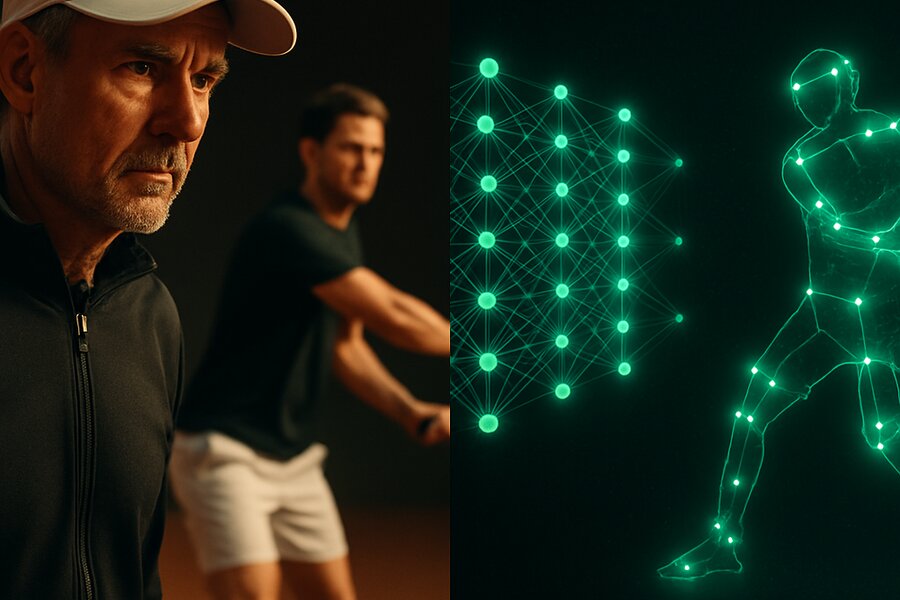
Most AI sports analysis platforms will tell you their models are trained on data. That is true — but it is not the whole story, and the part they leave out is often the most important. Data without expertise produces pattern recognition, not coaching intelligence. You can train a model on ten thousand forehand videos and teach it to identify what the most common forehand looks like. But common is not the same as correct, and describing what most players do is not the same as knowing what they should do.
OnCourtAI takes a different approach. Our AI models are not just trained on player data — they are built, validated and continuously refined using real input from qualified coaches and biomechanics specialists. This document explains how that process works, why it matters, and what it means for the quality of the analysis every player and coach receives on the platform.
The Problem With Data-Only AI in Sport
To understand why coach involvement in model training matters, it helps to understand the failure mode it prevents.
A model trained purely on video data learns to describe what it sees in the data. If the dataset contains mostly club-level players — which it inevitably does, because club players dramatically outnumber professional players — the model learns the statistical patterns of club-level play. A club-level forehand has a shorter backswing than a tour-level forehand. Club players more often contact the ball behind the ideal contact zone. The transition from preparation to forward swing is typically slower, and the follow-through is more variable.
A data-only model trained on this population will learn these patterns as the norm. When it then analyses an individual player's forehand, it will compare them to the club-level average rather than to the biomechanically optimal standard. A player who contacts the ball slightly ahead of the average club player might score well — even if that contact point is still well behind where it should be for genuine improvement. The model has learned what most players do, not what they should be working towards.
This is not a hypothetical problem. It is the most common failure mode in video-based sports AI, and it produces analysis that feels plausible but consistently underestimates the gap between where a player is and where they need to get to.
How OnCourtAI Encodes Coach Expertise
From the beginning, OnCourtAI has involved qualified coaches and biomechanics specialists in the development and validation of every analyser. The process has several distinct components.
Biomechanical Reference Models
For each stroke type — forehand, backhand, serve, volley, and all nine padel strokes — we work with coaches and sports scientists to establish biomechanical reference models: precise, evidence-based descriptions of what optimal technique looks like for each key component of the stroke. These are not derived from the average of what players in our dataset do. They are derived from biomechanical research, professional technique standards, and expert coaching consensus on what constitutes correct form at each level of development.
The reference model for a forehand contact point, for example, specifies the optimal horizontal and vertical position relative to the body at the moment of ball contact, the range of variation that remains within acceptable limits, and the threshold at which a deviation becomes a genuine fault with measurable consequences for power, consistency or injury risk. These specifications were established by coaches, not by statistical averaging of our player data.
Component Threshold Calibration
Each component score in our analysis is generated by comparing a player's measured biomechanical data against the reference model thresholds. These thresholds — the values that determine whether a measurement produces a score of 80 or 60 or 40 — are calibrated by coaches reviewing analysis outputs and real player videos together.
The calibration process works iteratively. We run the model on a set of player videos for which we have independent coach assessments. We compare what the model scores with what the coach observed. Where they diverge significantly, we investigate: is the model's measurement inaccurate, or is the threshold wrong, or is the coach's assessment reflecting a bias or a context the model cannot see? This three-way comparison — model output, coach assessment, biomechanical ground truth — is the calibration mechanism that keeps our scores meaningful rather than arbitrary.
This process is ongoing. Every time we update a model, we run it through the same calibration cycle before it goes to production. A model that has not been validated against expert coaching assessment does not ship.
Coach Attention Flag Development
The Coach Attention Flag system — which surfaces videos to coaches where the AI has identified a pattern worth direct attention — was developed entirely through coach input. We asked experienced coaches a specific question: given a player's analysis history, what patterns would make you want to intervene, and what patterns would you regard as within normal range or as a single-session anomaly?
The answers shaped the flag logic. A single low score does not trigger a flag — coaches told us single-session anomalies are common and rarely require urgent attention. A consistent pattern of low scores on the same component across multiple sessions does trigger a flag — because coaches told us that is when the pattern has become a habit that requires coaching intervention. A significant score drop from a player's recent average triggers a flag — because coaches told us sudden unexplained drops often indicate a technique regression, a physical issue, or a mental/confidence problem worth investigating.
Every flag condition in the system was defined by coaches, not derived algorithmically from the data. The algorithm implements the coaching judgment; it does not generate it.
Real Feedback from the Coach Community
Beyond the formal model development process, OnCourtAI benefits from a continuous feedback loop with the coaches who use the platform professionally. When a coach reviews a player's analysis and disagrees with a score, or when they identify a coaching note that is incorrect for a player's level or playing style, that feedback reaches us. Over time, patterns in coach feedback become inputs to model refinement.
This is a deliberately different approach from the standard machine learning cycle of train-on-data, deploy, collect-implicit-feedback. We treat coaches as subject matter experts whose explicit disagreements with the model's output are more valuable than a thousand implicit data signals from players who do not have the expertise to know whether the analysis is right. A coach who says "this contact point score is too generous for a player at this level" is giving us ground truth that data alone cannot provide.
The result is that our models improve in the direction of coaching accuracy, not just prediction accuracy. These are not the same thing. A model can become very good at predicting what score a player will receive without becoming any better at identifying what the player actually needs to improve. Coach feedback is the mechanism that keeps those two goals aligned.
Why This Makes OnCourtAI Different
The difference between a model trained with coach expertise and one trained purely on player data is not academic. It shows up directly in the quality and usefulness of the coaching advice players receive.
Coach-informed models produce analysis that is calibrated to what actually matters for improvement — not to what is statistically average. They identify faults at the right level of severity: not so sensitive that minor natural variations are flagged as problems, and not so lenient that genuine technique issues are scored as acceptable. They generate coaching notes that reflect the causal relationships between biomechanical faults — correctly identifying when a low score on follow-through is caused by a preparation problem rather than treating each component as independent.
For coaches using the platform, this accuracy is directly valuable: when the AI flags a pattern for coach attention, coaches can trust that the flag reflects a real pattern worth investigating, not a model artefact. When the score shows improvement, that improvement reflects a real change in biomechanics, not a data quirk. The analysis becomes a genuine supplement to coaching judgment rather than a number to be second-guessed.
An Ongoing Commitment, Not a One-Time Process
Model training with coach expertise is not a launch activity — it is a continuous commitment. Tennis and padel technique are not static. Understanding of biomechanical optimisation evolves as sports science research develops. Coaching best practices change as the professional game evolves. A model that was calibrated against expert consensus three years ago may not reflect current best practice today.
OnCourtAI maintains active relationships with coaches, biomechanics specialists and sports scientists who review our models, contribute to threshold calibration when we expand to new stroke types, and provide feedback when their professional experience diverges from our model outputs. The padel analyser set — covering all nine padel strokes — was developed with input from certified padel coaches, including review of the biomechanical thresholds against both published padel biomechanics research and professional padel coaching standards.
This is what it means to build AI that coaches trust: not a model that produces numbers, but a model whose numbers have been tested against expert judgment and refined until they reflect something real. Upload your next session at oncourtai.co.uk/mobile-app or explore the Coach Portal to see coach-informed AI analysis in action.