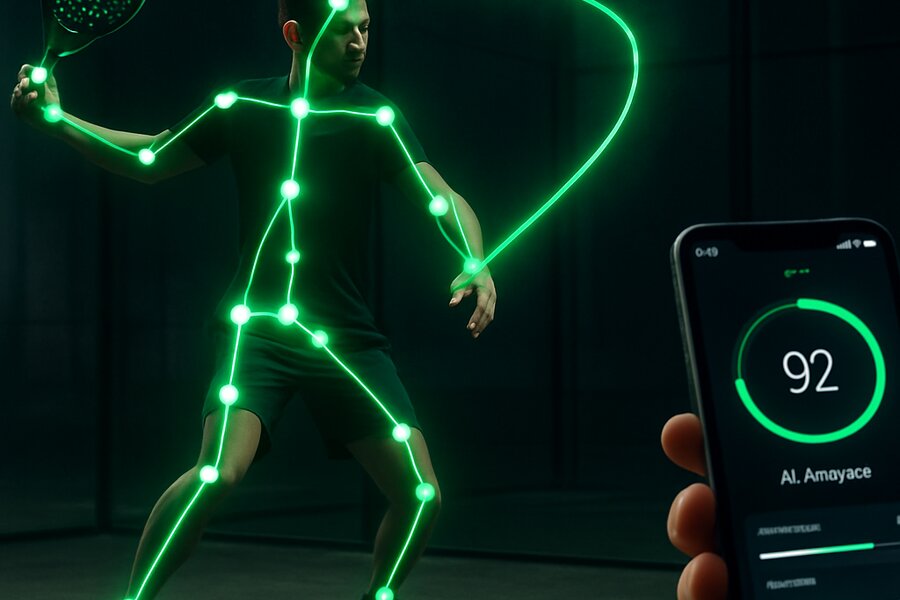
When we built OnCourtAI for tennis, the underlying philosophy was straightforward: every player deserves access to the kind of biomechanical analysis that was previously only available to professionals. The same philosophy applies to padel — and as of today, OnCourtAI analyses padel with the same depth and precision as tennis, covering all 9 padel strokes, from the forehand drive to the chiquita.
This article explains how the padel analysis works, what it measures, and why it is fundamentally different from anything else currently available to club padel players.
What OnCourtAI Analyses in Padel
Padel has nine distinct stroke types, each with its own biomechanical requirements, its own technique faults, and its own coaching priorities. OnCourtAI analyses all of them:
Forehand Drive — The padel forehand is shorter and more compact than a tennis forehand. The solid racket face rewards precise contact timing and a clean, controlled swing path. OnCourtAI tracks your backswing depth, contact point position, hip rotation, follow-through, and wrist stability at contact.
Backhand Drive — Padel backhand mechanics emphasise a compact, continental-grip motion. The AI tracks shoulder turn, racket preparation timing, contact point height, and arm extension, comparing your mechanics to optimal padel-specific standards rather than adapting tennis baselines.
Serve — The padel serve is underarm, with the ball bounced and struck at or below waist height. Unlike the tennis serve, power is not the primary metric — placement, spin, and height control are. OnCourtAI tracks the ball drop point, contact height, racket path, and the body rotation that generates controlled pace and spin without sacrificing accuracy.
Volley — Net control is central to padel. The volley is the most frequently played shot at higher levels, and its mechanics reward a firm wrist, a short compact punch action, and careful racket face angle management. OnCourtAI tracks your grip firmness indicators (derived from wrist joint angle stability), racket face angle at contact, and the punch-through motion that distinguishes a padel volley from a swinging groundstroke.
Lob — The lob is one of padel's most important tactical weapons. A well-executed defensive lob forces opponents off the net, resets the rally, and buys time. OnCourtAI tracks your racket face angle at contact (the open face needed to generate height), the upward swing path, and whether the lob clears the appropriate height to force the back-glass bounce.
Bandeja — The bandeja is padel's defensive overhead — a controlled, sliced smash played to maintain net position rather than win the point outright. The mechanics require a side-on trophy position, a sliced contact through the ball, and a controlled deceleration. OnCourtAI tracks your trophy position alignment, the slice angle at contact, and the follow-through that determines ball direction and spin.
Víbora — The víbora is the attacking overhead smash with sidespin — one of padel's most visually spectacular and technically demanding shots. The mechanics are similar to the bandeja but with more racket-head acceleration and a sharper cross-body slice that generates the ball's distinctive sideways kick. OnCourtAI tracks the racket path through the hitting zone, the degree of slice angle, and the shoulder rotation that drives the sidespin.
Smash — The flat power smash is padel's most aggressive overhead — played when the lob is short enough to attack outright. The mechanics prioritise contact height, arm extension at contact, and the pronation through impact that maximises power. OnCourtAI tracks these alongside your trophy position and the acceleration through the ball.
Chiquita — The chiquita is an advanced low sliced shot played at the feet of opponents approaching the net — one of padel's signature defensive-offensive hybrid shots. It requires a low contact point, an open racket face, and a precise slice that keeps the ball low and difficult to volley. OnCourtAI tracks your bend and contact height, the racket face angle, and the cross-court or inside-out trajectory you generate.
The Playtomic Score Scale
Padel players are familiar with the Playtomic skill rating system — the 1.0 to 7.0 scale used across clubs and apps worldwide to indicate player level. OnCourtAI displays your padel analysis results in this familiar format alongside our internal 0–100 technique score. A 1.0 represents a complete beginner; 7.0 represents elite professional level. Most active club players fall in the 2.0–4.0 range, with coaches and high-level competitive players typically in the 4.0–5.5 band.
The Playtomic-style band gives you an immediate sense of where your technique sits on the scale padel players actually use, while the 0–100 score tracks your precise improvement over time with enough granularity to notice meaningful change between sessions.
How the Analysis Works
The process is identical to the tennis analysis. You film your padel session on a smartphone — side-on, from 3-4 metres away, capturing your full body — and upload the video via the OnCourtAI Padel page or the mobile app's padel mode.
The AI processes 30,000 data points per 30-second clip, tracking 27 key biomechanical markers from your feet through your hips, shoulders, elbow, wrist and racket tip. It then scores your performance against padel-specific benchmark ranges — standards derived from the biomechanics of technically correct padel strokes, not adapted from tennis equivalents. The padel forehand is not a shorter tennis forehand. The padel serve is not a modified tennis serve. Each stroke is analysed against its own biomechanical reference model.
Component Scores and Coaching Advice
For each padel stroke you upload, you receive an overall technique score plus a breakdown of individual component scores — the specific biomechanical elements that contribute to your overall performance. A forehand drive might break down into: preparation timing, contact point, hip rotation, follow-through, and wrist stability. Each component is scored and explained, so you know exactly which part of the stroke is strongest and which needs the most attention.
Alongside each score, you receive personalised coaching advice generated by the AI based on your specific data. If your bandeja trophy position is consistently closing too early, you will not receive a generic tip about overhead mechanics — you will receive a specific description of what your trophy position data showed, why early closure reduces control and pace, and a drill to build the correct side-on position under pressure.
Progress Tracking and AI Chat
Every padel session you upload is stored and tracked over time. You can compare your component scores across sessions, watch your technique improve as you practice, and identify which strokes are developing fastest and which are plateauing.
The AI coaching chat also understands your padel data. Ask it why your víbora keeps sailing long, what your chiquita contact point data means, or how to structure a practice session to improve your net game — it has access to your actual biomechanical scores and gives you specific, data-grounded answers rather than generic coaching advice.
Who Is Padel Analysis For?
OnCourtAI's padel analysis is useful at every level. Beginners benefit from immediate, objective feedback on the basics — are you serving at the right height, is your contact point in the right position, is your swing path through the ball correct. Intermediate players use it to identify the specific technique gaps that are preventing improvement. Advanced players use it to fine-tune the overheads, develop the chiquita, and track marginal gains in their volley mechanics.
If you have a coach, the analysis supplements your coaching sessions with objective data between sessions. Your coach can see exactly what the AI measured, focus on the specific component that needs work, and track whether the improvements they are coaching are actually showing up in your biomechanics.
Upload your first padel session at oncourtai.co.uk/padel and find out what the AI sees in your game.