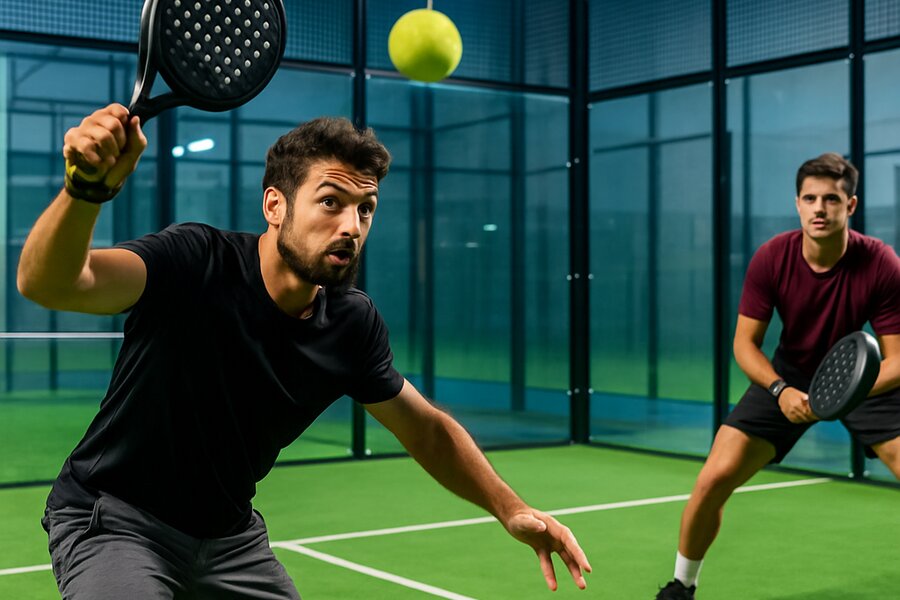
If you have been near a racket sport facility in the last few years, you have probably noticed something new: enclosed glass-walled courts, solid short-handled rackets without strings, and the distinctive sound of a ball bouncing off a back wall at pace. That is padel — and if you have not tried it yet, you are part of a shrinking minority.
Padel is officially the world's fastest-growing racket sport. With over 30 million players across more than 90 countries, it has gone from a niche South American curiosity to a global phenomenon in less than a decade. In the UK alone, the number of padel courts tripled between 2022 and 2025. In Spain, it overtook tennis in player numbers years ago. In Scandinavia, it has become the dominant social sport for the 25-45 demographic. The question is no longer whether padel matters — it is why it has taken the world by storm so quickly, and whether you should be playing it.
Where Padel Came From
Padel was invented in 1969 by Enrique Corcuera, a Mexican businessman who wanted to build a tennis court at his holiday home in Acapulco. The available space was too small for a full tennis court, so he improvised — using the walls of the property as boundaries and hanging a mesh fence to contain the ball. The result was something that played like a combination of tennis and squash, and the game spread from Mexico to Argentina and Spain over the following decades.
Spain became padel's spiritual home. The warm climate, the existing tennis culture, and the social nature of the sport (always played in doubles) made it an ideal fit. By the 1990s, padel was Spain's second most popular sport by participant numbers, and the first professional tour — the World Padel Tour — launched in 2005. Today, Spain has over 4 million active padel players and more padel courts than tennis courts.
The sport's global explosion accelerated dramatically after 2018, driven by social media, the visibility of professional padel on streaming platforms, and the endorsement of major tennis stars. Rafael Nadal invested in a padel club business. Andy Murray has been photographed playing. The crossover between tennis's existing infrastructure and padel's requirements (a padel court can be built in the footprint of a tennis court) meant existing clubs could add the sport quickly and cheaply.
The Court: What Makes Padel Different
The padel court is the defining feature of the sport and the main reason it plays so differently from tennis. A standard padel court is 20 metres long and 10 metres wide — roughly half the area of a tennis court. The playing surface is enclosed by walls: back walls of solid glass or mesh reaching 3-4 metres high, and side walls of solid material to a height of 4 metres that transition to open mesh above.
The walls are in play. This is the central tactical reality of padel that distinguishes it from every other racket sport. The ball can bounce off any wall after bouncing on the floor, and players can use the walls to play shots. A ball that goes past a player does not automatically lose the point — they can turn and play it off the back wall. A ball that hits the side wall and then the floor can be retrieved with an overhead. This wall play creates a fundamentally different tactical landscape from tennis, where the ball is lost the moment it passes you.
The net is the same height as in tennis — 88cm at the centre, 92cm at the posts. The service boxes are similar in dimension. The scoring system is identical to tennis: 15, 30, 40, deuce, advantage, games, sets, match.
The Racket and Ball
A padel racket is solid — no strings. It is made from composite materials (carbon fibre, fibreglass, foam core) with perforations that reduce air resistance and weight. The maximum dimensions are 45.5cm long and 26cm wide, with a maximum thickness of 38mm. The grip extends up to 20cm from the handle to the head.
The solid face gives padel its characteristic shot feeling: less spin generation than a strung racket, more dependence on pace control, angle, and timing. Padel rackets vary in shape — round heads give more control and a larger sweet spot; diamond and teardrop shapes concentrate weight higher in the head for more power on overheads. For beginners, a round or mid-round shape is recommended.
The padel ball is almost identical to a tennis ball but pressurised to a slightly lower internal pressure, producing a slower, more controllable bounce. The slower bounce, combined with the enclosed court, means rallies tend to be longer than in tennis and the sport is more forgiving for beginners.
How the Game Is Played
Padel is always played in doubles — two players per side. Singles padel exists but is extremely rare and not officially promoted by the sport's governing bodies. The social nature of doubles is considered one of padel's key growth drivers: it is inherently a team game, always played with and against other people, which makes it more social and more accessible than the often solitary grind of singles tennis practice.
The serve in padel is underarm only. The server must bounce the ball on the floor behind the service line and strike it at or below waist height. The ball must land in the diagonal service box (as in tennis), and it may then hit the side wall before the receiver plays it — but it may not hit the back wall before landing. The underarm serve makes the sport far more accessible to beginners than tennis, where the overhead serve is a major barrier to entry, while still allowing experienced players to develop spin, placement and tactical variation.
After the serve, all walls are in play. The central tactical framework of padel revolves around controlling the net — gaining the offensive net position and maintaining it through a combination of volleys, lobs, and the distinctive overhead smashes that are unique to the sport. The team that controls the net wins the vast majority of points at the higher levels of play.
The Scoring System
Padel uses the same scoring as tennis: points (15, 30, 40), games, and sets. Matches are typically played as best of three sets, with each set won by the first team to reach six games with a two-game lead. A tiebreak is played at 6-6. The similarity to tennis scoring means players who already know the tennis score system can pick up padel without learning new rules.
Why Padel Is So Addictive
Ask any padel convert why they play and you will hear a few consistent themes. First: it is easier to get into than tennis. The underarm serve removes the biggest barrier to entry. The enclosed court means the ball is always in play for longer — even a miss-hit bounces off a wall and gives you another chance. Beginners have fun from the very first session in a way that is genuinely rare in racket sports.
Second: the social element. Padel is a doubles game by design. Every game involves four people. Every session is inherently social. The enclosed court means you are always close to your opponents and your partner, and the wall play creates moments of surprise, improvisation and shared laughter that are uniquely padel. It is the reason padel courts in Spain and Scandinavia function more like social clubs than sports facilities.
Third: the tactical depth. Padel is easy to start and incredibly hard to master. The three-dimensional nature of the court — walls, angles, lobs that come back off the back glass, spinning overheads that kick unpredictably — creates a tactical richness that keeps experienced players fascinated for years. The bandeja, the víbora, the chiquita — these are shots that take months or years to develop and that change your game entirely when you do.
Getting Started
To start playing padel you need access to a court, a partner (ideally three, for a full doubles game), a padel racket and padel balls. Most tennis clubs that have added padel courts rent rackets and sell balls, so the equipment barrier is low. The fastest way to improve at the beginning is to focus on the basics: the underarm serve, the forehand and backhand drives, and — most importantly — learning to use the walls rather than fear them.
If you already play tennis, you will find padel initially disorienting in a specific way: your instinct to hit out and win the point directly works against you in padel, where the defensive possibilities of the walls mean that aggressive play is often neutralised and patience is rewarded. The greatest adjustment for tennis players is learning to lob, to use the walls offensively, and to prioritise net position over baseline power.
For AI-powered analysis of your padel technique — covering all 9 padel strokes including the serve, forehand drive, backhand drive, volley, lob, bandeja, víbora, smash and chiquita — visit OnCourtAI Padel and upload your first session.