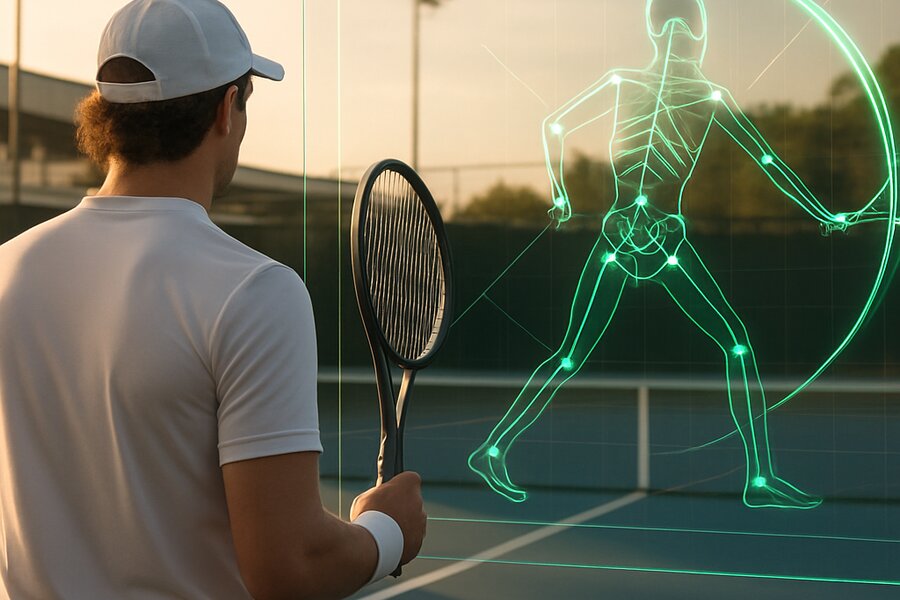
We ship improvements to OnCourtAI every week, but some months the changes are significant enough that they deserve a proper explanation. June 2026 is one of those months. Over the past few weeks we have rolled out three major upgrades that collectively represent the most meaningful improvement to the platform since we launched shot-by-shot analysis earlier this year. Here is what has changed — and what it means for your game.
Improved Analysis Models
The core of OnCourtAI is the AI model that watches your video and extracts biomechanical data from your swing. Everything else — the scores, the coaching advice, the progress tracking — flows from the accuracy of that model. So when we improve it, every part of the platform gets better.
The June model update focused on three areas that our data told us needed the most attention.
Better Tracking in Difficult Conditions
The previous model occasionally struggled with low-contrast backgrounds — indoor courts with white walls, outdoor courts where the player was backlit against a bright sky, and videos shot in mixed lighting conditions where part of the frame was in sun and part in shade. The updated model handles all of these substantially better. We retrained on a significantly expanded dataset that includes thousands of hours of footage from indoor facilities, covered courts, and outdoor courts captured in challenging lighting. The result is more consistent tracking accuracy regardless of where you film.
For players who primarily train indoors, this is a meaningful improvement. The previous model would sometimes lose tracking on the racket hand when it passed in front of a white background, which would produce gaps in the data and occasionally affect scoring accuracy. That issue is now resolved in the vast majority of cases.
More Accurate Contact Point Detection
Identifying the exact frame of ball-racket contact is one of the hardest problems in video-based tennis analysis. The ball is moving at speed, the racket is accelerating through the hitting zone, and the contact event itself lasts only a few milliseconds. Getting this right matters because so many coaching metrics depend on it: contact point height, arm extension at contact, racket face angle at contact, and the transition from acceleration to deceleration.
The updated model uses a refined detection algorithm that combines visual cues (the ball deformation, the brief pause in its trajectory) with biomechanical signals (the peak in wrist angular velocity, the reversal in forearm rotation) to pinpoint contact with greater precision. In our validation testing, contact frame accuracy improved from 91% to 96% — meaning the model identifies the correct contact frame 96 times out of 100, compared to frames labelled by expert human analysts.
This improvement flows through to every metric that references the contact point, which is most of them. Your scores are now more accurate, your frame-by-frame analysis snaps to the right moment more reliably, and the coaching advice you receive is grounded in a more precise reading of what actually happened at the most critical moment of the stroke.
Enhanced Serve Analysis
The serve is the most biomechanically complex stroke in tennis — a full kinetic chain from leg drive through hip rotation, shoulder turn, elbow extension, wrist snap and pronation, all coordinated in a sequence that takes less than a second. Our serve model has received a dedicated update that improves its ability to track the trophy position, measure toss height and placement, and assess the back-scratch position and racket acceleration through the hitting zone.
The practical impact is most visible in the serve-specific metrics. Trophy position scoring is now more nuanced, correctly distinguishing between a textbook trophy position and the abbreviated motion that many club players use under time pressure. Toss placement analysis now accounts for the intended serve direction, so a toss that lands slightly to the right is not flagged as a fault when the player is hitting a slice serve out wide.
More In-Depth Statistics
Data is only as useful as the way it is presented. We have always tracked a wide range of biomechanical metrics, but in June we significantly expanded the statistics available to every player and improved how they are displayed.
Component Score Breakdown
Your overall technique score has always been composed of individual component scores — preparation, swing path, contact point, follow-through, footwork, and more depending on the stroke type. What is new is the level of detail available within each component. Preparation is no longer a single number: you can now see your backswing timing relative to the ball bounce, your shoulder rotation angle at the start of the forward swing, and your racket position at the top of the backswing — each scored individually with clear explanations of what the AI measured and what the ideal range looks like.
This granularity matters because it turns a vague instruction like "improve your preparation" into a specific, measurable focus: "your shoulder rotation at the top of your backswing is averaging 72 degrees — the target for your stroke type is 85-95 degrees." That is the kind of precision that accelerates improvement because the player knows exactly what to work on and can measure whether it is changing.
Kinematic Sequence Visualisation
The kinematic chain — the sequence in which your body segments accelerate and decelerate during a stroke — is the foundation of efficient power generation in tennis. We now display this as an interactive visualisation that shows the acceleration timeline of your hips, shoulders, elbow and wrist throughout each stroke. You can see at a glance whether your kinetic chain fires in the correct sequence (hips first, then shoulders, then arm, then wrist) and whether there are any segments that fire too early, too late, or not at all.
This is a metric that was previously only available through expensive biomechanics lab testing. Making it available from a standard smartphone video is one of the things we are most proud of in this update.
Ball Statistics
For strokes where the ball is visible, we now estimate incoming ball speed and post-contact ball speed. These statistics give you a clearer picture of how effectively you are transferring energy through the stroke — which is ultimately what determines how fast, accurate and consistent your shots are in a match context.
Smarter AI Coaching Chat
The AI coaching chat has been part of OnCourtAI since early 2026, and it has always been one of the most popular features on the platform. Players use it to ask follow-up questions about their analysis, get drill suggestions, understand what their scores mean and plan their practice sessions. In June, we upgraded the underlying language model to a significantly more capable version — and the difference in the quality of coaching conversations is immediately noticeable.
Deeper Understanding of Your Data
The new model does not just access your scores — it understands the relationships between them. If your contact point score is low and your preparation score is also below average, the AI now recognises that these are likely connected (late preparation leads to a rushed swing and a late contact point) and addresses the root cause rather than treating them as two separate issues. This kind of causal reasoning makes the coaching advice substantially more useful because it prioritises the changes that will have the biggest cascading effect on your game.
More Specific Drill Recommendations
The upgraded model generates drill recommendations that are more precisely targeted to your specific weaknesses and more clearly described. Instead of generic instructions, you get drills with specific ball feeds, specific footwork patterns and specific focus points that directly address the biomechanical issue the AI identified. Many players have told us that these drill recommendations are now comparable to what they would receive from a private coaching session.
Conversational Memory Within Sessions
The AI coach now maintains better context throughout a conversation. If you ask about your forehand contact point, then follow up with "what about on the backhand?", the model understands the context and gives you a comparative answer rather than starting from scratch. This makes the coaching conversation more natural and more efficient — closer to the kind of back-and-forth you would have with a real coach who has just watched you play.
What Is Coming Next
These updates are not the finish line — they are the foundation for what comes next. We are actively working on real-time analysis feedback (processing your video while you are still on court), expanded stroke type coverage, and deeper integration between the AI coaching chat and your historical progress data so the coach can track your improvement over time and adjust its recommendations accordingly.
If you have not tried OnCourtAI recently, now is the perfect time. The platform is significantly more capable than it was even three months ago. Upload a session at oncourtai.co.uk/mobile-app and experience the difference for yourself.