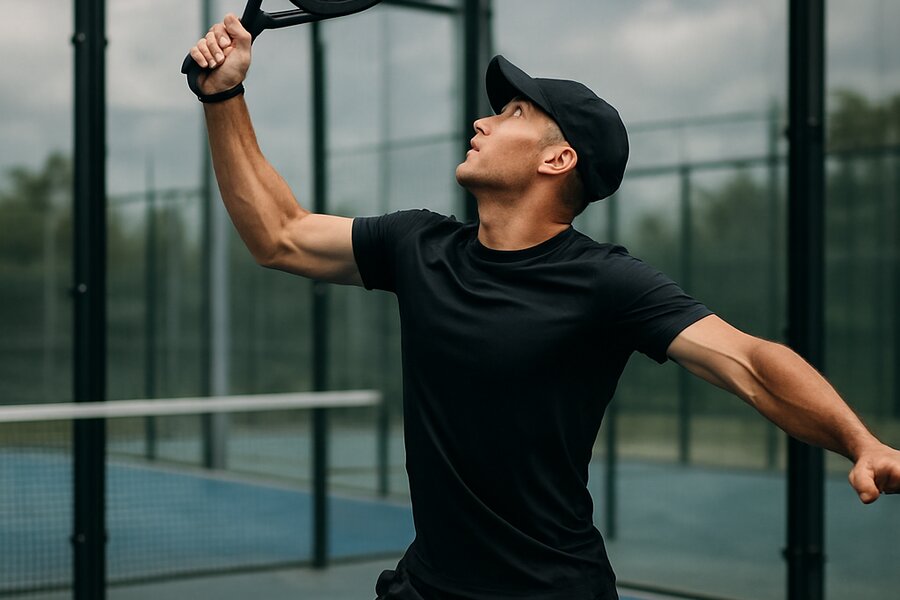
If you want to understand padel at a deeper level than a beginner — if you want to understand why the sport at higher levels looks so different from recreational padel — the place to start is the three overhead shots. The bandeja, the víbora, and the smash are not variations on the same theme. They are three distinct weapons with different mechanics, different tactical purposes, and different levels of difficulty, and knowing when to use each one is what separates a developing padel player from an accomplished one.
In tennis, there is essentially one overhead: the smash. In padel, there are three, each evolved to address a specific tactical situation that arises from the unique geometry of the enclosed court. This article explains all three — what they are, how the biomechanics differ, when to use each, and what the most common technique errors look like.
The Bandeja — The Tactical Defensive Overhead
The bandeja (Spanish for "tray") is padel's most important overhead for net players, and arguably the shot that most clearly illustrates the tactical difference between padel and tennis. In tennis, when you reach the net and your opponent lobs over your head, you either smash it outright or concede the point. In padel, you have a third option — and it is often the best one: the bandeja.
The bandeja is a controlled, sliced overhead smash designed not to win the point directly but to maintain your net position while keeping the ball in play. A well-executed bandeja lands deep in the opponent's court, kicks away sideways, and bounces into the back glass — making it difficult to return aggressively and buying your team time to reset at the net. The goal is control, not power.
Bandeja Biomechanics
The trophy position for the bandeja is side-on to the net, with the non-dominant shoulder pointing forward and the racket raised behind the head. Unlike a tennis smash, where you want to face slightly more front-on to maximise the hitting angle, the bandeja requires a strongly side-on body position throughout the contact phase. This side-on alignment is what enables the slice — the characteristic cutting motion through the back of the ball that generates the low trajectory, sidespin, and controlled depth that define a good bandeja.
The contact point is slightly in front of and to the side of the dominant shoulder — not directly overhead as in a flat smash. The racket comes through the ball from high to low and outside to inside, with the face open (angled slightly back) at contact to produce the slice. The wrist rolls slightly through the shot, but the key feature is the deceleration after contact — deliberately checking the swing to prevent the ball from going long, which is the most common fault.
The follow-through is short and controlled, finishing with the racket face pointing diagonally down and across the body. This abbreviated follow-through is counter-intuitive for players coming from tennis, who have been taught that a full follow-through is always desirable. In the bandeja, cutting the follow-through short is a feature, not a fault — it is what keeps the ball in the court on a shot hit from close to the net at a relatively low trajectory.
When to Use the Bandeja
Use the bandeja when the lob is good — high enough, or deep enough, that you cannot comfortably reach the contact point for a flat smash without moving back behind the service line. The bandeja lets you take the ball earlier, maintain your net position, and keep the tactical pressure on your opponents. It is the correct choice for the majority of lobs you face at the net in padel.
Common Bandeja Faults
The most common fault is closing the body too early — turning to face the net before contact, which eliminates the side-on position and prevents the slice. The second most common fault is swinging too hard and losing the controlled trajectory that makes the shot effective. A bandeja that goes fast and flat is no longer a bandeja — it is a poor smash that has given up the net position you were trying to maintain.
The Víbora — The Attacking Sidespan Overhead
The víbora (Spanish for "viper") is the shot that most surprises players from outside padel. It looks superficially similar to the bandeja — a side-on overhead with a slicing motion — but it is more aggressive, more technically demanding, and produces a completely different ball flight. Where the bandeja is a control shot, the víbora is an attacking weapon.
The defining characteristic of the víbora is the sharp sidespin it generates — a lateral kick that causes the ball to bounce sharply sideways off the court surface and, in the hands of an experienced player, into the side glass at an angle that is almost impossible to retrieve. A well-hit víbora is one of the most spectacular and effective shots in padel, and it is the overhead that most distinguishes high-level from intermediate play.
Víbora Biomechanics
The setup for the víbora is similar to the bandeja — side-on trophy position, racket raised behind the head. The difference is in what happens at and after contact. The víbora requires a much sharper cross-body motion through the ball: the racket comes from outside-in at a steeper angle than the bandeja, making contact further in front of the body, and the racket face slices across the back of the ball at a more pronounced angle. The result is more sidespin and less backspin compared to the bandeja.
The contact point is higher than the bandeja — ideally at full arm extension, as high as you can reach while maintaining the side-on alignment. The wrist snap at contact is more pronounced than in the bandeja, generating the additional racket-head speed that transfers into the sidespin. The follow-through is cross-body — the racket finishes across to the non-dominant side of the body in a motion that mirrors the direction of the sidespin.
Shoulder rotation is the engine of the víbora. The power in the shot comes from the unwinding of the shoulders through the contact, with the arm and wrist snap adding the spin. Players who try to generate the shot from the arm alone consistently produce a flat, directionless ball that lacks the sidespin kick that makes the víbora effective.
When to Use the Víbora
The víbora is the right choice when the lob is short or mid-height — low enough that you can reach a high contact point comfortably, but in a situation where a flat smash would be too risky or too telegraphed. It is also the correct choice when you want to direct the ball to the side glass at a sharp angle, particularly when attacking the weaker side of the opponent at the net. At higher levels, the víbora replaces the flat smash as the default attacking overhead because it combines pace with the unpredictable bounce that makes it so difficult to retrieve.
Common Víbora Faults
The most common fault is hitting the víbora too hard and too flat — reverting to a power smash when the sidespin is lost. This usually happens when players close the body early (the same fault as the bandeja) or fail to maintain the outside-in swing path through contact. The second most common fault is taking the contact too low — losing the advantage of height and reducing the angle of attack.
The Smash — The Power Overhead
The flat smash is padel's most aggressive overhead and the one most familiar to tennis players. It is played when the lob is short enough — hanging in the air, or dropping to a comfortable height — that you can make flat contact at full extension and drive the ball down into the court with pace. The goal is to win the point directly, either through a ball that bounces twice before the opponents can reach it or through a ball aimed at the back glass that kicks too fast to retrieve.
Smash Biomechanics
The padel smash shares significant mechanics with the tennis overhead. The trophy position involves the body turned side-on, the non-dominant arm raised to track the ball, and the dominant arm raised with the racket behind the head in the throwing position. Contact is made at full arm extension, as high as comfortably possible, slightly in front of the body.
The key difference from the tennis overhead is the pronation and the follow-through. In padel, the follow-through is generally shorter than in tennis — you do not need as much forward swing to generate pace because the solid racket and the shorter court mean less power is needed than in a full tennis smash. The pronation at contact (the rotation of the forearm that squares the racket face and accelerates through the ball) is similar to tennis, but the overall swing is more compact.
Contact point height is the most important variable. The higher the contact point, the steeper the angle down into the court, and the less likely the ball is to hit the back glass at a retrievable height. A flat smash aimed at the back glass at a sharp downward angle is the most difficult shot for opponents to handle — the ball comes off the glass fast and low, and the recovery time is minimal.
When to Use the Smash
The smash is the right choice when the lob is genuinely attackable — short, mid-height, and in front of your body. The temptation for players learning padel is to try to smash everything, but padel's back glass means that a flat smash into a deep lob often gives opponents an easy back-glass retrieval. Use the smash when you are confident of a high, clean contact point. When in doubt, the bandeja is safer.
Common Smash Faults
The most common fault is using the smash on lobs that are too deep — attempting a flat smash from behind the service line and producing a ball that bounces into the back glass at a retrievable height. The second most common fault is a low contact point that produces a flat ball with insufficient downward angle to make the shot effective.
Training All Three Overheads with AI Analysis
The bandeja, víbora and smash each have distinct biomechanical profiles — and that makes AI analysis particularly valuable for developing them. It is very difficult to feel the difference between a correctly sliced bandeja and a poorly closed bandeja in the moment of hitting the shot. It is hard to know whether your víbora is producing genuine sidespin or just pace. It is easy to mistake a low-contact smash for a well-timed one when it feels powerful.
OnCourtAI analyses all three overheads, tracking your trophy position, contact point height, swing path angle, follow-through length, and the wrist mechanics that distinguish the slice of the bandeja and víbora from the flat drive of the smash. Upload a session focusing on one overhead type and receive specific, measurable feedback on which biomechanical elements are working and which need attention.
Visit oncourtai.co.uk/padel to analyse your overhead game and start developing all three with data-driven coaching.