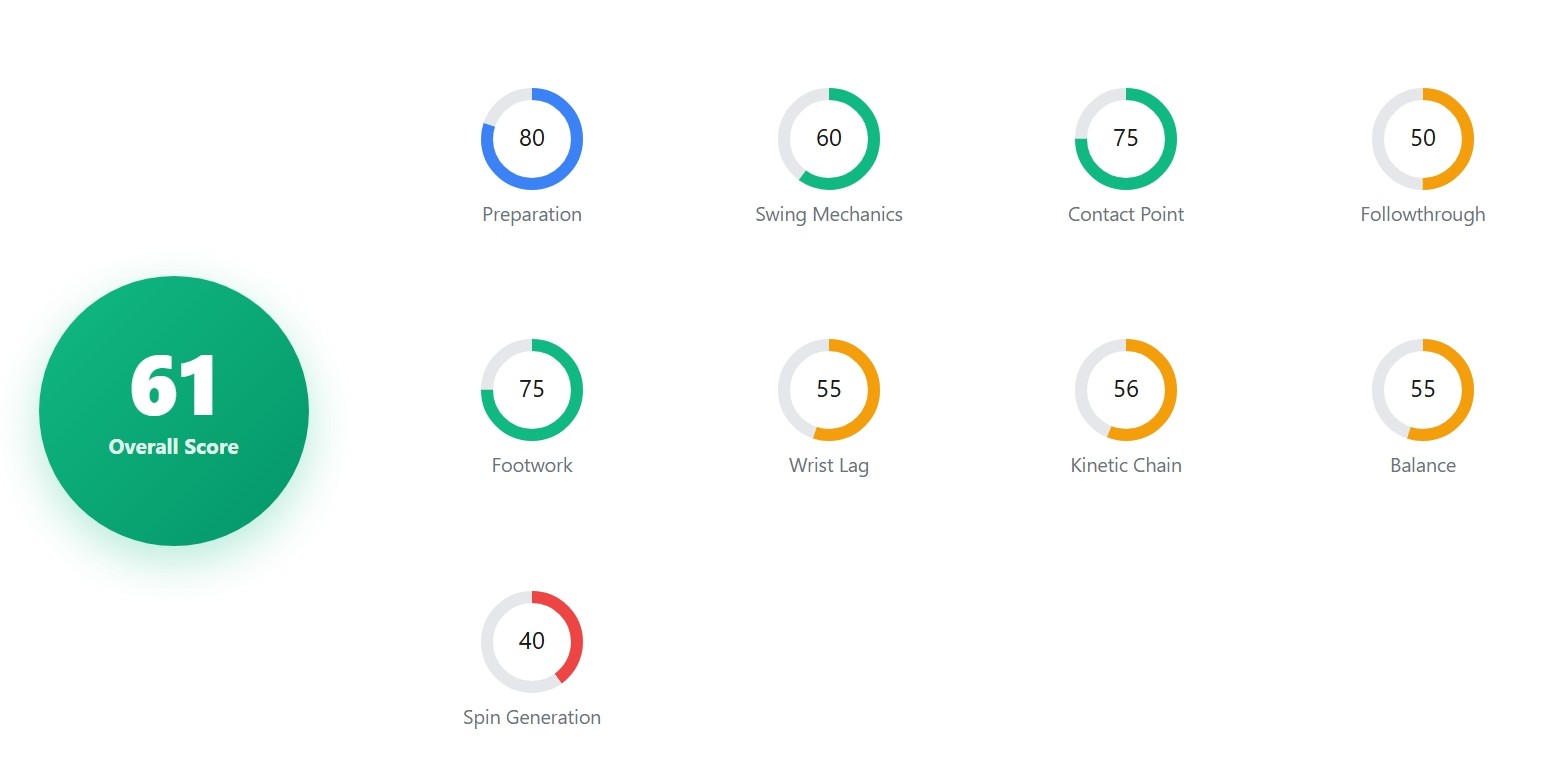
In the fast-paced world of modern tennis, where milliseconds can determine a point's outcome, stroke analysis has become the secret weapon for players at all levels. Whether you're a weekend warrior trying to perfect your forehand or a competitive athlete aiming for tournament success, understanding the mechanics of your strokes is crucial.
That's where OnCourtAI comes in – our revolutionary AI-powered platform analyses an average of 30,000 data points in just a 30-second video, providing in-depth insights that traditional coaching simply can't match.
This comprehensive guide to tennis stroke analysis will break down the key stages of the tennis swing, explain how AI is transforming technique improvement, and showcase the unique features that make OnCourtAI the go-to tool for serious players in 2025.
Why Tennis Stroke Analysis Matters More Than Ever
Tennis stroke analysis is more than just watching videos in slow motion – it's a scientific approach to breaking down every aspect of your swing to identify strengths, weaknesses, and opportunities for improvement.
Traditional analysis relies on the coach's eye and experience, which, while valuable, can miss subtle details that make a big difference. At OnCourtAI, we use advanced computer vision and machine learning algorithms to capture data points that the human eye can't detect.
For a typical 30-second video clip of your practice or match, our system processes over 30,000 individual measurements. This includes everything from joint angles and racket speed to ball spin and contact point precision.
Players who regularly use stroke analysis improve their technique scores by an average of 28% within three months.
The 5 Key Stages of the Tennis Swing: AI-Powered Breakdown
1. Preparation Phase: The Foundation of Every Stroke
The preparation phase begins the moment you recognize the incoming ball and lasts until the start of your backswing. This is where 40% of stroke errors originate, according to our analysis.
Key elements we analyse:
- Shoulder turn: Optimal 45-60 degrees for power generation
- Hip rotation: 30-45 degrees separation from shoulders (the 'X-factor')
- Grip adjustment: Micro-movements that predict stroke success
- Foot positioning: Split-step timing and balance distribution
2. Backswing Phase: Building the Power Coil
The backswing is where you load energy for the strike. Our AI detects common faults like excessive racket drop (common in serves) or insufficient coil (in groundstrokes).
3. Contact Phase: The Moment of Truth
This micro-second phase determines 70% of shot quality. OnCourtAI analyses contact at over 30fps equivalent through AI interpolation.
4. Follow-Through Phase: Completing the Motion
Often overlooked, but crucial for consistency and injury prevention.
5. Recovery Phase: Ready for the Next Shot
The swing doesn't end at follow-through — recovery positions you for the rally.
OnCourtAI: The Ultimate Tennis Stroke Analysis Tool
While traditional analysis might capture 100-200 data points per session, OnCourtAI processes 30,000+ per 30-second video. Here's what sets us apart:
- Real-Time Processing: Get insights during your lesson
- Biomechanical Depth: 32 markers across 5 swing phases
- Pro Comparisons: Side-by-side with Djokovic, Nadal, Federer
- Personalized Drills: AI-generated exercises based on your weaknesses
- Progress Tracking: Weekly reports with visual graphs
- Injury Prevention: Flags high-risk patterns early
Our platform has helped players improve their average stroke score from 50.4 to 60.8 in 2025.
Ready to Transform Your Game?
Don't let poor technique hold you back. With OnCourtAI, world-class stroke analysis is now available to everyone.