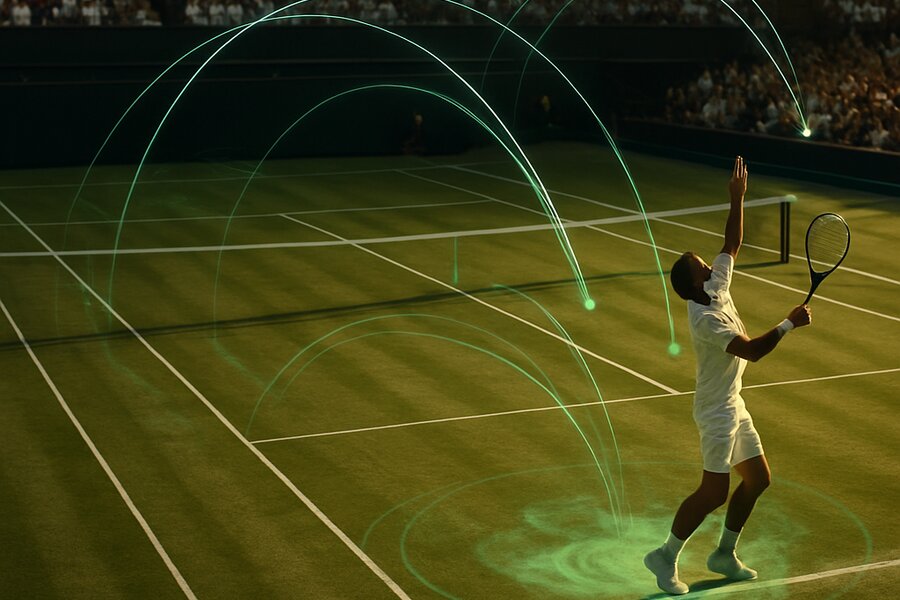
Wimbledon has always been a tournament that balances tradition with innovation. The grass is still manicured to exactly 8mm. The players still wear all white. The trophies are still presented by members of the Royal Family. But behind the pristine lawns and strawberries-and-cream elegance, The Championships have become one of the most technologically advanced sporting events on the planet — and in 2026, artificial intelligence is at the centre of almost everything.
This article explores how Wimbledon is deploying AI across the tournament in 2026, what it means for the sport, and how the same underlying technology is now available to every club player through platforms like OnCourtAI.
AI-Powered Match Insights
The most visible AI deployment at Wimbledon 2026 is the real-time match insight system powered by the tournament's long-standing technology partnership with IBM. Building on the Watson AI platform that has been part of Wimbledon's infrastructure for over a decade, the 2026 system generates real-time narrative insights during every match on every court.
These are not simple statistics. The AI watches the match in real time — processing ball tracking data, player positioning, stroke type classification, and point outcome patterns — and generates natural language insights that contextualise what is happening. When a player wins four consecutive points on their second serve, the system does not just report the statistic. It identifies that the player has shifted to a more aggressive second serve placement pattern, notes that this adjustment came after they lost three consecutive second-serve return points in the previous game, and explains the tactical significance of the change.
These insights are delivered to broadcasters, the Wimbledon website, the official app, and in-ground digital displays around the venue. They give every fan — whether watching from Centre Court or following on a phone — access to the kind of tactical analysis that previously required years of professional coaching experience to produce in real time.
Automated Highlight Generation
With 18 courts in simultaneous play during the first week, Wimbledon generates more tennis footage in a fortnight than most broadcasters can process in a year. Traditionally, human editors would watch every match and select the key points for highlights packages — a process that was labour-intensive, slow, and inevitably missed compelling moments on lower-profile courts.
In 2026, AI handles the initial highlight selection across all courts simultaneously. The system analyses every point and assigns an excitement score based on multiple factors: rally length, winner type (ace, drop shot, passing shot, volley), crowd noise level, tactical significance within the match (break point, set point, match point), and player reaction intensity. Points above a threshold are automatically tagged and clipped, creating a raw highlights package for every match within minutes of its conclusion.
Human editors then curate the final broadcast packages from this AI-generated pool — selecting the best moments, adding context, and ensuring narrative flow. The result is that highlights from Court 14 are available just as quickly as highlights from Centre Court, and moments that would have been missed entirely in previous years are now captured, clipped and distributed within minutes.
Player Performance Prediction
One of the most talked-about AI applications at Wimbledon 2026 is the pre-match performance prediction system. Using historical match data, surface-specific performance metrics, recent form, head-to-head records, and even weather conditions, the AI generates a probabilistic forecast for each match — not just who is likely to win, but how the match is likely to unfold.
The system might predict that a particular matchup is likely to go to five sets, that one player's forehand crosscourt will be the decisive shot, or that the match is likely to hinge on second-serve performance in the third set. These predictions are presented as contextual overlays during broadcasts and on the Wimbledon app, giving viewers a framework for understanding the tactical battle as it develops.
The predictions are not always right — tennis is too variable and too dependent on the mental state of individual players for any model to be consistently accurate. But they provide a starting point for intelligent analysis, and when the match diverges from the prediction, that divergence itself becomes an interesting talking point. Why did the player who was predicted to dominate on serve suddenly struggle in the second set? The AI's framework makes that question visible to every viewer, not just expert analysts.
Fan Experience and Engagement
Beyond the competitive analysis, Wimbledon 2026 is using AI to enhance the fan experience in several innovative ways.
The official Wimbledon app features an AI chatbot that can answer questions about the tournament in real time — from match schedules and results to historical records and player biographies. The chatbot draws on the tournament's extensive archive and can handle nuanced questions like "When was the last time a qualifier reached the quarter-finals on grass?" or "What is the longest fifth-set tiebreak in Wimbledon history?"
For on-site attendees, the app uses AI-powered recommendations to suggest which court to visit based on the current state of play across the tournament, the viewer's stated preferences (favourite players, preferred match types), and real-time crowd density data. If you are particularly interested in watching close matches, the app will alert you when a match on an accessible court enters a deciding set.
The digital signage around the grounds is also AI-driven in 2026, with displays updating dynamically to show live scores, trending moments, and contextual facts about the matches currently in progress. The content is generated automatically, ensuring every display is current and relevant without requiring manual updates across the estate.
Broadcast Innovation
Wimbledon's broadcast coverage has integrated AI at multiple levels in 2026. Camera selection — the choice of which angle to show at any given moment — is now AI-assisted, with the system predicting where the ball is likely to go based on player positioning and selecting the optimal camera angle a fraction of a second before the shot is played. This produces smoother, more anticipatory coverage that follows the action more naturally than traditional manual switching.
Commentators receive real-time AI-generated briefing notes during matches, providing statistical context, historical comparisons and tactical observations that they can weave into their commentary. This gives even less experienced commentators access to the depth of knowledge that previously only the most seasoned analysts could provide on the fly.
The AI also powers the automated subtitling and translation services that make Wimbledon's coverage accessible in dozens of languages simultaneously — translating not just the commentary but the contextual match insights, ensuring that fans worldwide receive the same depth of analysis regardless of their language.
What This Means for Club Players
The most remarkable thing about the AI technology deployed at Wimbledon in 2026 is not that it exists — it is that much of the underlying technology is now accessible to every tennis player. The gap between what a Grand Slam tournament can measure and what a club player can measure has narrowed dramatically.
Consider what Wimbledon's AI does: it tracks player movement, analyses stroke biomechanics, identifies technique patterns, generates coaching insights, and produces natural language explanations of what the data means. OnCourtAI does the same thing — from a smartphone video, uploaded by any player, on any court, anywhere in the world.
The scale is different, obviously. Wimbledon has 24 Hawk-Eye cameras per court, dedicated computing infrastructure, and a team of engineers maintaining the system in real time. OnCourtAI works from a single camera angle captured on a phone. But the analytical principles are the same, and the practical output — actionable coaching insight derived from objective biomechanical measurement — is comparable.
This democratisation of technology is arguably the most important trend in tennis right now. The same AI that helps broadcasters explain what Novak Djokovic is doing differently on his second serve in a Wimbledon quarter-final can now help a club player in Manchester understand what they are doing differently on their forehand in a Saturday morning league match. The data is different in scale but identical in nature.
The AI Future of Tennis
Wimbledon 2026 offers a glimpse of where tennis is heading. Within a few years, we expect to see real-time on-court coaching assistance (AI-generated tactical advice delivered to players during changeovers), automated match officiating that supplements or replaces line judges on every court, and personalised viewing experiences that adapt the broadcast to each viewer's interests and expertise level.
For club players, the trajectory is equally exciting. OnCourtAI is already delivering biomechanical analysis, AI coaching chat, progress tracking and the Court Report podcast — all built on the same foundational AI technology that powers Wimbledon's most advanced systems. As the technology improves, the analysis will become faster, more detailed, and more tightly integrated with your on-court experience.
The grass at Wimbledon may still be 8mm, but the technology measuring what happens on it has never been more advanced — and it has never been more available to every player who wants to improve their game. Upload your next session at oncourtai.co.uk/mobile-app and bring a piece of Wimbledon-level analysis to your own court.