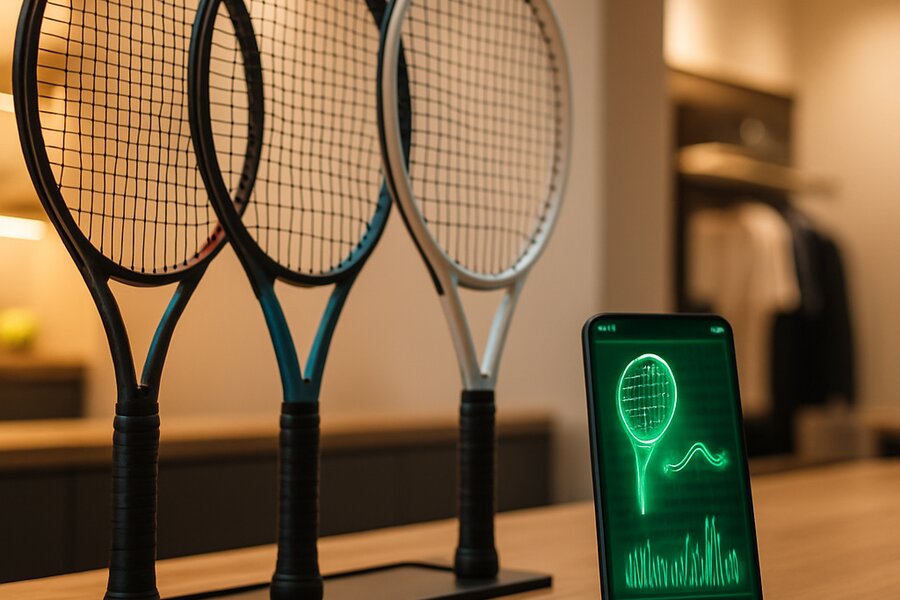
Choosing a tennis racket has always been one of the most consequential — and least scientific — decisions a player makes. Walk into any tennis retailer and you will be asked a handful of questions: what level do you play at, how often do you play, do you like power or control? Based on those answers, a sales assistant will point you towards a wall of options and hope for the best. It is a process that has barely changed in three decades, and it fails players in ways that most never even realise.
The problem is not that the people giving advice are unqualified. Many are experienced players and coaches. The problem is that the information they are working with — your subjective self-assessment of your own game — is fundamentally insufficient. A player who describes their forehand as "pretty solid" might have excellent racket head speed but a chronically late contact point. A player who says they "need more power" might actually be generating plenty of racket speed but losing energy through poor wrist stability at contact. These distinctions matter enormously when choosing a racket, and they are invisible without data.
That is where AI-powered racket selection enters the picture — and it is changing the way players, coaches and retailers think about equipment choice.
The Traditional Approach and Its Limitations
The conventional racket selection process relies almost entirely on self-reported information and broad categorisation. Players are typically segmented by level (beginner, intermediate, advanced), playing style (baseline, serve-and-volley, all-court) and physical characteristics (height, strength, age). These categories are then mapped to racket specifications: head size, weight, balance point, stiffness and string pattern.
This approach works at the extremes. A genuine beginner benefits from a lightweight, large-headed, forgiving frame. An advanced tournament player likely knows what specifications they prefer. But the vast majority of club players — the players in the middle, where the differences between rackets genuinely matter for development — get a recommendation that is based more on marketing segmentation than biomechanical reality.
The result is that millions of players are using rackets that do not match their actual swing characteristics. A frame that is too stiff for a player with a short, compact swing will transmit shock and encourage arm problems. A racket that is too head-heavy for a player with slow racket preparation will make their timing worse, not better. A string pattern that is too open for a player who already generates heavy topspin will produce inconsistency rather than the extra spin the player was hoping for.
None of these mismatches are obvious to the player. They feel like "I just can't find my rhythm" or "my arm hurts after long sessions" — problems that players attribute to their technique or fitness rather than their equipment.
What AI Racket Selection Actually Measures
AI-powered racket selection works from objective biomechanical data rather than subjective self-assessment. Instead of asking you what kind of player you are, it analyses what kind of player you actually are — by looking at your real swing.
The process starts with a video upload. Using the same biomechanical analysis technology that powers OnCourtAI's stroke analysis, the AI extracts detailed metrics from your swing: racket head speed at contact, the angle and path of your swing arc, your wrist stability through the hitting zone, your contact point relative to your body, and the efficiency of your kinetic chain from feet through hips, shoulders and arm.
These metrics are not decorative. Each one maps directly to specific racket characteristics. A player with high racket head speed but poor wrist stability benefits from a slightly heavier, more stable frame that dampens vibration and keeps the racket face steady through contact. A player with an efficient kinetic chain and a full follow-through can handle — and will benefit from — a more control-oriented frame with a denser string pattern, because they are generating their own power organically. A player with a short, compact swing and moderate racket speed will get better results from a lighter, more powerful frame that compensates for the shorter swing path.
The key insight is that these recommendations are not opinions. They are the direct, measurable consequence of matching physical racket properties to individual biomechanical profiles. It is the same logic that a professional racket fitter uses when they work with a touring professional — the difference is that AI makes it available to every player, from every video they upload.
How OnCourtAI's Racket Finder Works
OnCourtAI's Racket Finder is our implementation of this technology. It works by combining the biomechanical data from a player's uploaded sessions with a curated database of racket specifications, then running a matching algorithm that scores each frame against the player's actual swing profile.
The scoring algorithm evaluates five key dimensions: power generation (how much the player needs the racket to contribute versus how much they generate through technique), control demand (how much precision the player's swing path and contact consistency already deliver), comfort requirements (based on swing speed, impact vibration and contact point consistency), spin compatibility (whether the player's swing path and racket angle at contact would benefit from an open or dense string pattern), and manoeuvrability needs (based on preparation speed, swing tempo and the physical demands of the player's typical shot selection).
Each dimension is weighted and scored based on the player's real data, not a questionnaire. The result is a ranked list of racket recommendations with a clear explanation of why each frame suits — or does not suit — that specific player's biomechanics.
The Racket Finder is available to OnCourtAI users who have uploaded at least one session, and it is also available as an embeddable widget for tennis retailers who want to offer AI-powered racket selection on their own websites. Retailers can integrate the widget with a single script tag, branded to their store, with recommendations drawn from their own catalogue.
Why This Matters for Your Game
Playing with the right racket does not magically fix technique problems. But playing with the wrong racket can create them — or make existing ones worse. A frame that fights against your natural swing pattern adds friction to every shot you hit. Over hundreds of hours of play, that friction compounds. It slows improvement, increases injury risk and makes the game less enjoyable.
Conversely, a well-matched racket removes unnecessary obstacles. Your technique feels cleaner because the racket is working with your biomechanics rather than against them. Your arm stays healthier because the frame is absorbing impact in a way that suits your swing speed and contact pattern. Your improvement curve steepens because the racket is not masking the feedback loop between technique change and result.
This is not marginal. For a club player who has been using a mismatched racket for years, switching to a properly matched frame can produce an immediate and noticeable improvement in consistency, comfort and confidence. It is one of the highest-return changes a player can make — and AI racket selection makes it accessible to everyone, not just the players who have access to a professional fitter.
The Role of Retailers
For tennis retailers, AI-powered racket selection represents a fundamental shift in how equipment is sold. Instead of relying on customer self-assessment and sales expertise alone, retailers can now offer a data-driven recommendation service that builds customer confidence and reduces returns.
The OnCourtAI Racket Finder widget is designed specifically for this use case. A customer uploads a short video of their swing — even recorded on their phone at a local court — and receives a personalised recommendation from the retailer's own product catalogue within minutes. The retailer benefits from higher conversion rates, better customer satisfaction and fewer returns from equipment mismatches. The customer benefits from a recommendation that is genuinely personalised to their game, not their self-description of it.
If you are a retailer interested in adding AI-powered racket selection to your website, visit our partners page to learn more about the integration process.
The Future of Equipment Selection
AI-powered racket selection is still in its early stages, but the trajectory is clear. As biomechanical analysis becomes more precise — tracking not just the swing arc but the micro-adjustments a player makes under different match conditions — racket recommendations will become increasingly specific. We envision a future where your equipment recommendation updates as your game develops: as your swing speed increases through training, as your contact point improves, as your technique evolves, the AI adjusts its recommendation to match your current biomechanics rather than the snapshot it captured six months ago.
The days of choosing a racket based on a five-minute conversation in a shop are numbered. The data exists. The technology exists. And the difference it makes is measurable. Upload your first session at oncourtai.co.uk/mobile-app and see what the data says about your game — and your racket.