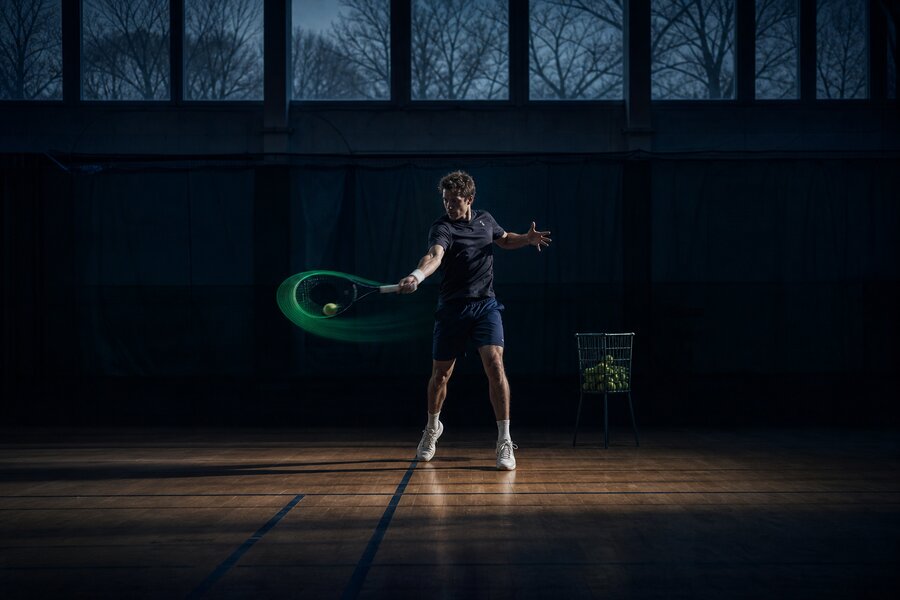
Every October the same thing happens across northern Europe. The clocks go back, the outdoor courts turn green and slippery, indoor court time doubles in price, and your coach's winter slots were taken in August by people more organised than you.
We can see this in our own numbers. Analyses on the platform peaked at 541 in July, fell to 418 in August, and dropped again to 303 in September. Players are not filming less because they stopped caring. They are filming less because they are playing less.
Which is a shame, because the off-season is the single best window in the year for technical change — and the only one where you have any realistic chance of rebuilding something.
Why Winter Is Actually the Right Time
You cannot rebuild a stroke in the middle of a season. Technical change makes you temporarily worse, and nobody volunteers to get worse in June when there are matches on Saturday. So faults get managed rather than fixed, year after year.
Winter removes that excuse. There are no results to protect. If your forehand gets messy for three weeks in November while you move your contact point forward, the cost is nothing.
The constraint is not motivation. It is feedback. Working alone in a sports hall in January, you have no idea whether the change you are trying to make is actually happening. That is the specific gap worth closing.
What You Can Genuinely Do Indoors, Alone
Be realistic about the setting. You likely have a sports hall, a wall, or an hour of indoor court shared with someone else. Here is what that supports.
Shadow swings, filmed. This sounds trivial and is the most underrated off-season tool there is. No ball, no net, no court needed — just space. Film twenty shadow forehands, run them through analysis, and you get scored on preparation, swing path, balance and follow-through without ever striking a ball. Technique components that do not depend on ball contact are perfectly readable this way.
Wall work. A wall gives you repetitions at a rate no coach can feed. It is poor for depth and power, excellent for contact point and preparation, because the ball comes back faster and punishes late racket preparation immediately.
Serve practice into a net or hall. The serve needs no partner, and it is the stroke that decays fastest over winter. A basket of balls and a quiet corner is enough. The serve is also the stroke our data shows improves most slowly, which means it needs the long runway that winter provides.
Off-court strength. Pooling the component scores across every training plan generated on the platform, the weakest areas in the amateur game are spin generation (35 out of 100), kinetic chain (48), hip rotation (49) and knee bend (51). Those four are describing one underlying fault: generating racket speed with the arm instead of with the ground and the body. Some of that is technique. A meaningful part is that the legs and trunk cannot do what is being asked of them — and that is fixable in a gym in February.
Replacing the Coach's Eye
The thing a coach provides that is hardest to replace is not instruction. Most players already know roughly what they should be doing. It is observation — someone who notices that you have stopped doing the thing you were asked to do, usually about four minutes after you stopped.
Working alone, that feedback loop is broken. You believe you are making the change. You almost certainly are not, or not as much as you think.
This is the narrow, specific job video analysis does well. It does not have opinions, it does not get bored, and it will tell you that your contact point moved four centimetres when you were convinced you had transformed the stroke. That is deflating and extremely useful.
Our advice is to film at the start of the off-season, pick one component, and film again in three to four weeks. Not to see if you feel better — to see if the number moved.
Let the Plan Do the Structuring
Winter training falls apart because it has no shape. You go to the hall, hit for an hour, and do roughly what you did last time.
This is what My Plan is for. It reads the analyses already in your account, finds the components where you are genuinely weakest, and builds a structured multi-week programme around them: sessions, blocks, named drills, durations, and what each drill is targeting. Across the platform it has now generated 862 sessions containing 4,020 individual drills, each tied back to a real component score from a real video.
The typical plan runs around five weeks, three sessions a week, at roughly an hour a session. That is almost exactly the shape of a European off-season block, which is not a coincidence — it is what players told the system they could commit to.
It also splits the work sensibly: roughly two thirds technique, with the remainder divided between match play and fitness. The fitness sessions exist precisely because a knee bend score of 51 is often a strength problem wearing a technique costume.
One Thing at a Time
The most common off-season mistake is ambition. A player looks at their component scores, sees five numbers under 55, and decides to fix all five.
They fix none. Motor learning does not work in parallel — attention is the bottleneck, and splitting it across five faults means none of them get the repetitions required to become automatic.
Take the lowest score you can realistically work on in your setting. Work only on that until the next video. Spin generation is the most common weakness we find — it was the top-priority fault in 17 of the 22 plans we could analyse — but it is also the hardest to self-correct, because it needs a swing path rebuilt rather than a detail adjusted. If you are working alone, a more tractable target like contact point or preparation will give you a better winter.
Keep the Habit, Not Just the Intention
The clearest finding in our own data is about persistence rather than talent. Players who build up ten or more analysed sessions improve 70% of the time, against 52% for players with fewer. We tested that against 500 random shuffles of the data and it held up — the pattern is real, not an artefact of counting.
Most players who never reach that point do not quit in a dramatic way. They stop in October and intend to start again in April.
Four or five filmed sessions between now and spring is a low bar. It is also, on our numbers, roughly the difference between arriving in April where you left off and arriving genuinely better.
A Realistic Winter
Film a baseline this month, while you still remember your summer form. Pick one component. Work it indoors with whatever you have — wall, hall, shadow swings, gym. Film again in late November, and again in January.
Come spring, you will know whether the winter worked, which is more than most players can say.