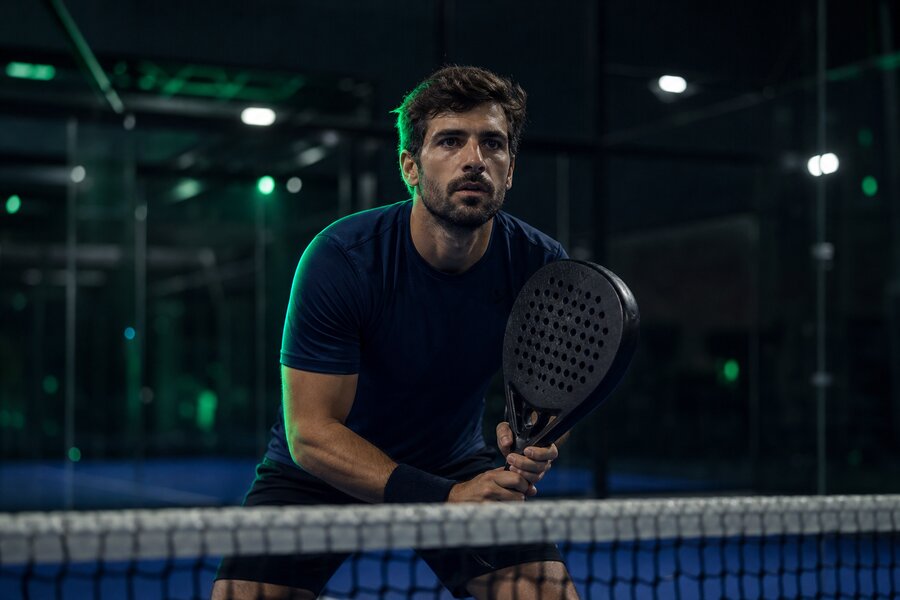
To hit a bandeja, turn side-on, take the racket up and out to the side with your elbow level with your shoulder, and meet the ball in front of you at eye level with your arm fully extended. Swing sideways across your body rather than down through the ball, and keep the follow-through flat. The aim is not to win the point. It is to send the lob back deep and slow enough that you and your partner keep the net.
That short answer is the whole shot. The rest of this guide explains each part, why it matters, and the mistakes that most often turn a bandeja into a weak smash or a ball that sails into the back glass.
What is a bandeja?
The bandeja (Spanish for "tray") is an overhead you play when an opponent lobs you at the net. In tennis you would either smash the lob or run back for it. In padel a smash from the wrong position usually bounces off the back glass and gives your opponents an easy ball, so the bandeja exists as a third option: a controlled overhead, hit with slice, that lands deep and keeps you in your attacking position.
It is the overhead you will play most often at club level. Our guide to all three padel overheads covers where it sits alongside the víbora and the smash. This page is only about the bandeja.
The four checkpoints of a good bandeja
These checkpoints come from the padel coach who helped us build OnCourtAI's padel analysis. They are what the coach looks for when watching a player hit the shot, and they are the same things our model measures from your video.
- Elbow level with your shoulder. As you prepare, your hitting elbow should be up at shoulder height, with the racket out to the side. A dropped elbow lowers the whole swing and forces you to hit up at the ball.
- Contact in front, at eye level, with the arm fully extended. The bandeja is not hit directly above your head like a smash. Meet the ball slightly in front of you, roughly level with your eyes, with your arm straight.
- A sideways swing across your body. The racket travels across the body, not up from low to high and not straight down. This sideways path is what puts the slice on the ball.
- A flat follow-through. After contact the racket stays roughly level as it finishes. It does not dive down towards your feet. That flat finish is the clearest difference between a bandeja and a víbora.
Underneath all four sits body rotation. You turn side-on as the lob goes up and rotate through the shot, so the swing comes from your body and not just your arm.
Step by step
1. Turn and move early
As soon as you see the lob, turn side-on, non-hitting shoulder towards the net. Move with small side steps so the ball ends up slightly in front of you. Most bad bandejas are footwork problems: the ball gets behind you and no amount of arm technique can save it.
2. Prepare with the elbow up
Lift the racket up and out to the side, elbow level with your shoulder. Point your free hand up at the ball. It helps you track the lob and keeps your shoulders level.
3. Meet the ball at eye level
Let the ball drop to roughly eye height, slightly in front of you, and reach up to it with a straight arm. Waiting for it to drop this far is what lets you control the shot. Taking it as high as possible is a smash habit.
4. Swing sideways and stay flat
Brush across the back of the ball with a slightly open racket face. Keep the swing travelling sideways and let the racket finish level, then recover straight back into your net position.
The most common bandeja mistakes
- Letting the ball get behind you. You end up leaning back and pushing the ball up. Turn and move earlier.
- Dropping the elbow. The racket comes from too low, the swing goes upwards and the ball floats long.
- Hitting too high, too hard. Trying to take the ball at full stretch and with pace turns it into a poor smash that comes back off the glass.
- Finishing low. If your racket dives down after contact, you have hit a different shot. That downward finish belongs to the víbora, and without the rest of the víbora technique it usually just puts the ball in the net.
- Facing the net too early. Opening your chest before contact removes the rotation and the slice.
When to play a bandeja, and when not to
Play a bandeja when the lob is good enough to push you back but not so good that you have to let it bounce. It is the safe, default answer to most lobs at club level. If the lob is short and you are well balanced, you can attack with a víbora or a smash. If the lob is over you and deep, let it go and play it off the back glass instead.
Not sure which overhead you are actually hitting? Read our bandeja vs víbora guide. Many players think they are hitting one when their swing says the other.
Drills to groove the bandeja
- Shadow swings with a pause. Without a ball, freeze at the preparation position and check your elbow height in a mirror or phone camera, then swing through and freeze again at the finish to check it is flat.
- Feed-and-recover. A partner feeds lobs from the back of the court. Play a bandeja, then touch the net with your racket before the next feed. It trains you to treat the shot as a way of staying forward.
- Target the back corners. Put two towels in the deep corners of the opposite court. Depth and direction matter more than pace.
How OnCourtAI analyses your bandeja
Film yourself side-on and choose Bandeja in the padel analysis. OnCourtAI tracks your body through the shot and checks each of the coach's checkpoints: elbow height at preparation, whether contact is at eye level with an extended arm, how far the racket travels sideways, and whether the follow-through stays flat. You get a score out of 100 for each part and plain-English advice on the weakest one.
It is worth being clear about what video alone cannot tell you. OnCourtAI measures your body, not the ball, so it cannot see the spin you put on the ball or where it lands. It tells you whether your technique matches what a coach is looking for. Every analysis also comes with a data-quality rating, so you know how far to trust it. Filming side-on with your whole body in frame gives the best results. Our guide to filming for AI analysis applies to padel too.