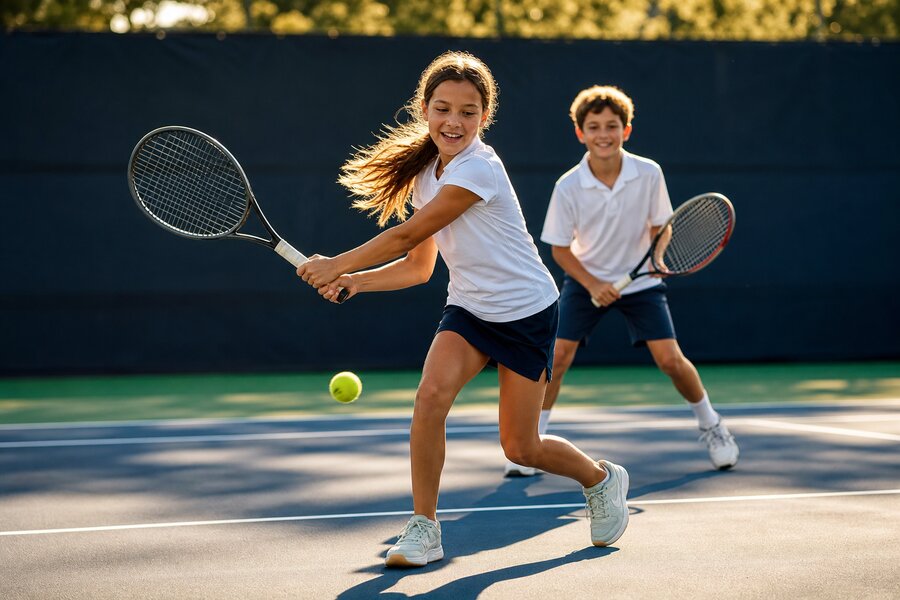
Ask a room of adults why they stopped playing tennis as a teenager and you get remarkably consistent answers. It got too serious. They were not good enough. They stopped winning. It stopped being fun.
Almost nobody says they lost interest in hitting a tennis ball. They lost interest in the structure built around hitting a tennis ball.
That is worth sitting with, because it means the problem is a design problem, and design problems can be fixed. Several other sports have fixed versions of it already.
What Makes Tennis Unusually Hard on Juniors
Tennis has three structural features that combine badly for a young player.
You lose alone, in public. In football, a heavy defeat is shared between eleven people and nobody is individually responsible. In tennis every loss is entirely yours, watched by whoever is standing by the fence — frequently including your parents. For a thirteen-year-old that is a lot of exposure, repeatedly.
Half of all players lose every match. This is arithmetic, not pessimism. In any tournament draw, one player goes home happy. If your only measure of progress is results, the sport guarantees that most participants experience mostly failure.
Improvement is invisible for long stretches. Technical progress in tennis is slow and often imperceptible week to week. A junior can genuinely improve for six months and lose to the same opponent throughout, because the opponent improved too. Without a way to see progress that is not the scoreboard, it feels like standing still.
Put those together and you have a sport that asks young people to tolerate public, individual, apparently unrewarded failure for years. Some children thrive on that. Most quietly leave.
Football: Make the Unit Bigger Than the Child
Grassroots football's genuine achievement is not skill development. It is that a child can be comfortably the eighth-best player in a team and still have a thoroughly good time every Saturday for a decade.
The team absorbs individual variance. Bad days are diluted. There is a social reason to turn up that survives a run of poor form, and a role for a player who is not the best.
Tennis has a version of this and chronically underuses it: team tennis, club leagues, box leagues, doubles. In countries where junior tennis is organised around clubs and teams rather than individual rankings, retention is visibly better. The lesson is not complicated — give a child a reason to turn up that does not depend on them personally winning.
Skateboarding: Progress Without Opponents
Skateboarding is brutally difficult, has essentially no coaching infrastructure for most participants, and offers no guaranteed success. Teenagers stay with it anyway, often obsessively.
The reason is that progress is defined against the trick, not against another person. You either landed it or you did not. Nobody has to lose for you to succeed, and the improvement is unmistakable — yesterday you could not do this, today you can.
It is also self-paced and self-selected. You choose the next trick, which gives a sense of ownership that handed-down drill sheets rarely do.
Tennis could borrow this directly. "Hit ten forehands in a row past the service line" is a trick. So is "serve three in a row into the deuce box". These are achievements a child can own, attempt alone, and clear without anyone else losing.
Swimming: Measure the Thing That Is Actually Improving
Swimming's retention trick is the clock.
A young swimmer can finish last in every race in a gala and still go home pleased, because they took one and a half seconds off their personal best. The scoreboard says they lost. The stopwatch says they improved. Both are true, and the stopwatch is the one that keeps them coming back.
This is the single most transferable idea on this list, and it is the gap tennis has never properly filled. Tennis has always had results and has never had a stopwatch — a measure of your own progress that is independent of who you played.
This is precisely what technique measurement provides. A junior whose forehand scores 54 in September and 61 in January has improved, demonstrably, regardless of what happened in the county tournament. That is a swimmer's personal best, applied to technique.
And the component scores make it more useful still, because they localise the gain. "Your contact point went from 48 to 63" is a specific, earned thing a child can point at.
Gaming: Visible Progression and Instant Feedback
It is tempting to treat video games as the competition for children's attention. More useful is to ask why they hold it so well.
Games give constant, immediate feedback on actions. They show progression explicitly — levels, unlocks, statistics that only ever go up. They set goals just beyond current ability. And crucially, failure is cheap, private and instantly retryable.
Tennis inverts almost all of this. Feedback arrives weekly from a coach, progression is invisible, goals are set by adults, and failure is public and expensive.
We are not suggesting tennis should be gamified with badges. But "make progress visible and feedback fast" is a sound principle that tennis has simply never applied to the thing juniors spend most of their time on: hitting the ball.
What This Looks Like in Practice
Some of this is organisational and belongs to clubs and federations. Some of it is available to any parent or coach now.
Separate the two scoreboards. Results are one thing; improvement is another. Talk about them separately and never let a loss erase a measured gain. "You lost, and your serve is the best it has been" is a completely coherent sentence that most juniors never hear.
Give them a stopwatch equivalent. Film a stroke every few weeks and let the child watch their own numbers move. Our data shows the forehand responds fastest to video feedback, which makes it the right place to start with a junior who needs an early win.
Let them choose the target. Skateboarding's ownership effect is real. Show a junior their component scores and let them pick which one to attack. A self-chosen goal survives a bad week far better than an imposed one.
Make some of it team-shaped. Doubles, box leagues, club matches. Anything where turning up has a social reason that outlasts a dip in form.
Keep the measurement private by default. This one matters. The value of a personal best is that it belongs to the child. Published junior leaderboards recreate exactly the public comparison that drove them out in the first place. Our platform ranks adults locally and nationally, and that is appropriate for adults who opted in — for juniors, the useful comparison is with themselves three months ago.
The Honest Limits
Technology is not the main lever here, and it would be self-serving to pretend otherwise.
The biggest determinants of whether a junior stays in tennis are the coach's manner, the parents' behaviour in the car on the way home, whether they have friends at the club, and cost. No app affects any of those. A child who dreads the drive home will not be rescued by a technique score.
What measurement can do is narrower: it can make improvement visible during the long stretches when results do not reflect it. That is one specific failure mode of junior tennis — the child who is genuinely getting better, cannot see it, and concludes they are not good enough.
That child is worth keeping, and they are losable for entirely avoidable reasons.
The Question We Keep Asking
Junior tennis is not short of talented coaches or committed parents. What it is short of is ways for a young player to feel they are getting somewhere on the days they lose.
Swimming solved that with a clock. Skateboarding solved it with tricks. Football solved it with a team.
Tennis has the hardest version of the problem and, until recently, the fewest tools for it. That is changing, and the first step is simply to stop treating the result as the only thing worth measuring.