Padel is won and lost at the net. At every level above beginner, the team that controls the net wins the vast majority of points. The rally pattern in padel is almost always the same: the team at the net attacks, the team at the baseline defends, and the outcome depends on whether the defending team can lob effectively enough to force the net team back or whether the net team can maintain their position long enough to find a winning overhead or volley.
This means that the two most important skills in padel — the ones that determine how well you control the net — are the serve and the volley. The serve gives you the opportunity to approach the net immediately. The volley is the weapon you use once you are there. Both are unique to padel in important ways, and both reward deliberate practice and precise technical understanding.
The Padel Serve: Different From Everything You Know
If you come from tennis, the padel serve requires a complete mental reset. Everything you have learned about serving in tennis — the trophy position, the toss, the overhead contact, the kick and slice variations — is not just irrelevant but actively counterproductive. The padel serve is an underarm motion, completely unlike the overhead action of tennis, and it requires its own biomechanical framework.
The Rules of the Padel Serve
The server must stand behind the service line, within the service box, and the ball must be bounced on the floor before being struck. The contact must be made at or below waist height — contact above the waist is a fault. The ball must land in the diagonal service box, and it may then bounce off the side wall before the receiver returns it. If the ball hits the back wall before landing in the service box, it is a fault.
There is no second serve in padel in the traditional sense — there are two serves, as in tennis, but the padel serve is considerably lower-risk than the tennis serve, and double faults are uncommon at any level above beginner.
Serve Biomechanics
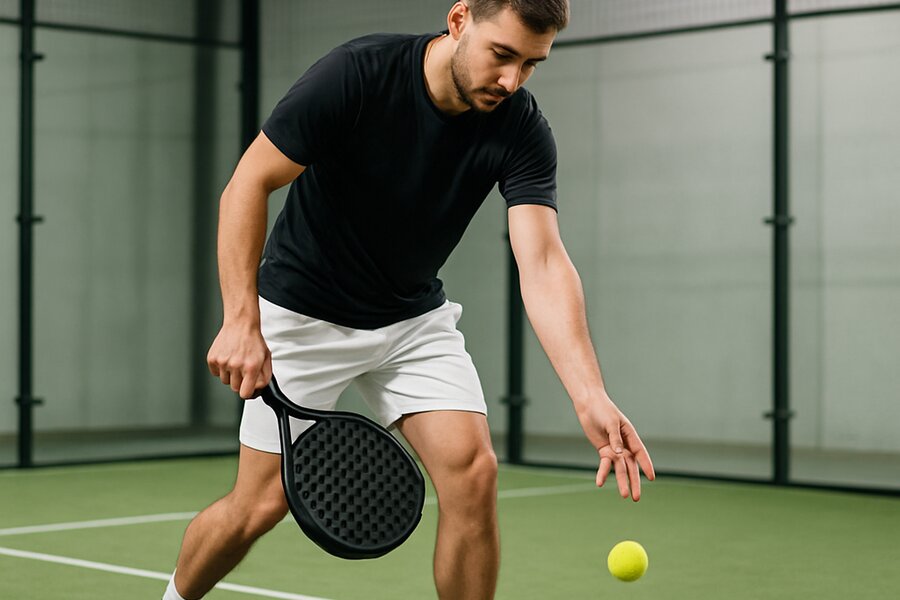
The correct padel serve stance has the body positioned sideways to the net, weight initially on the back foot. The ball is held in front of the body, dropped or lightly bounced to waist height, and struck with a low-to-high or level swing path as the weight transfers from back to front foot.
The grip is continental — the same grip used for volleys and the bandeja — positioned so that the bevelled edge of the racket sits diagonally in the palm rather than flat. This grip enables the variety of spin options that make the padel serve genuinely effective: a flat serve struck through the ball for pace, a slice serve that angles the ball into the side wall, and a top-spin option that produces a rising ball difficult to attack.
The most important mechanical element of the padel serve is the contact point. Unlike tennis where the contact point is high overhead, in padel it must be below the waist. Most beginners contact the ball too high — still unconsciously trying to find the tennis serve motion — and produce a flat, attackable ball. The lower the contact point (within the legal waist limit), the more upward swing path you can use, which generates more topspin and produces a higher, more difficult bounce.
Hip rotation is the engine of the padel serve. The serve generates pace not from a big arm swing but from the body turn — the rotation of the hips and torso from side-on to front-on through the contact point. A server who generates pace through body rotation will be more consistent and less injury-prone than one who relies on arm speed alone.
Serve Tactics
The padel serve's primary tactical purpose is not to win the point directly — aces are rare because the court is small and the serve speed is modest — but to set up an immediate approach to the net. The serving team serves and advances, ideally arriving at the net as the receiver plays their return. A good serve makes the return difficult — forcing the receiver to defend rather than attack — which allows the serving team to take net position comfortably.
The most effective serve placements are: into the body (giving the receiver limited room to swing), into the side wall at a sharp angle (producing a difficult bounce), and deep and high with topspin (giving the serving team more time to advance to the net). Flat, central serves at medium height are the easiest for opponents to attack and should generally be avoided.
Common Serve Faults
Contact above the waist is the most common fault for beginners, producing a fault call. For more experienced players, the most common technical errors are insufficient body rotation (relying on the arm for pace), a contact point too far in front of the body (reducing control), and a flat swing path (losing the topspin or slice that makes serves difficult to attack).
The Padel Volley: The Foundation of Net Control
The volley in padel is the most frequently played shot at intermediate and advanced levels. At the net — the dominant tactical position — almost every shot you play is a volley. Groundstrokes at the net are almost never played in padel; a ball that bounces at the net position is unusual, and when it occurs, the correct response is usually a quick punch volley rather than a full groundstroke swing.
The padel volley is fundamentally a blocking and redirecting motion — a compact punch action that uses the opponent's pace and adds angle, rather than a full swing that generates its own power. Padel nets control is not about overpowering opponents from the net; it is about precisely redirecting the ball to locations that are difficult to reach, at heights that are difficult to attack.
Volley Biomechanics
The continental grip is essential for the padel volley — the same grip used for the serve. This grip allows you to volley effectively on both sides without changing grip, which is critical at the net where there is no time for grip changes between shots.
The volley stance is low and balanced — knees bent, weight distributed evenly, racket in front of the body in the ready position. Staying low is the single most important mechanical element of padel volley technique. Players who stand tall at the net are consistently beaten by balls aimed at their feet — the most common attacking strategy at the baseline. A low ready position allows you to reach low volleys comfortably and keeps you prepared for both directions.
The swing for a padel volley is short — a punch action rather than a swing. The backswing is minimal: the racket moves back only as far as the shoulder, and often less. The forward motion is a firm, controlled push through the ball, with the wrist locked and stable. A loose wrist at contact produces an inconsistent, uncontrolled volley; a firm, stable wrist produces a precise, penetrating ball that is difficult for opponents to attack.
Racket face angle at contact is the primary control variable. A slightly closed face produces a flat, penetrating volley. A more open face produces a slower, angled volley that drops away from opponents. For low volleys — balls below net height — the face must be sufficiently open to lift the ball over the net while still directing it with accuracy.
Volley Tactics
The tactical purpose of the volley at the net is to maintain net position and create pressure, not to try to win every point with a winner. Attempting winners from the volley too often leads to errors and concedes the net position that took effort to establish.
The most effective volley patterns are: angling the ball sharply to the sides (exploiting the width of the court), directing the ball to the opponents' feet (forcing difficult low volleys from players trying to approach), and a combination of deep, aggressive volleys and short, angled volleys that forces opponents to cover ground. The key is variation — unpredictable direction, pace, and height.
Common Volley Faults
Standing too tall is the most common volley fault. The second is taking too big a backswing — swinging at the ball rather than punching it — which produces a slow, loopy volley with no penetration. The third is an unstable wrist at contact, producing unpredictable direction and inconsistent power. The fourth — very common for tennis players — is changing grip for the backhand volley. Stay on continental for everything.
Improving Both Shots with AI Analysis
OnCourtAI analyses both the padel serve and the volley as part of its complete 9-stroke padel analysis. For the serve, the AI tracks your contact height, body rotation, swing path and the resulting ball trajectory characteristics. For the volley, it tracks your racket face angle at contact, wrist stability, backswing length, and the punch-through motion that determines penetration and direction.
Because both shots are so fundamental to net control — and because net control is so fundamental to padel — improving your serve and volley mechanics will have an immediate impact on your match results. Upload your padel session at oncourtai.co.uk/padel and see exactly what the AI sees in your serve and volley technique.