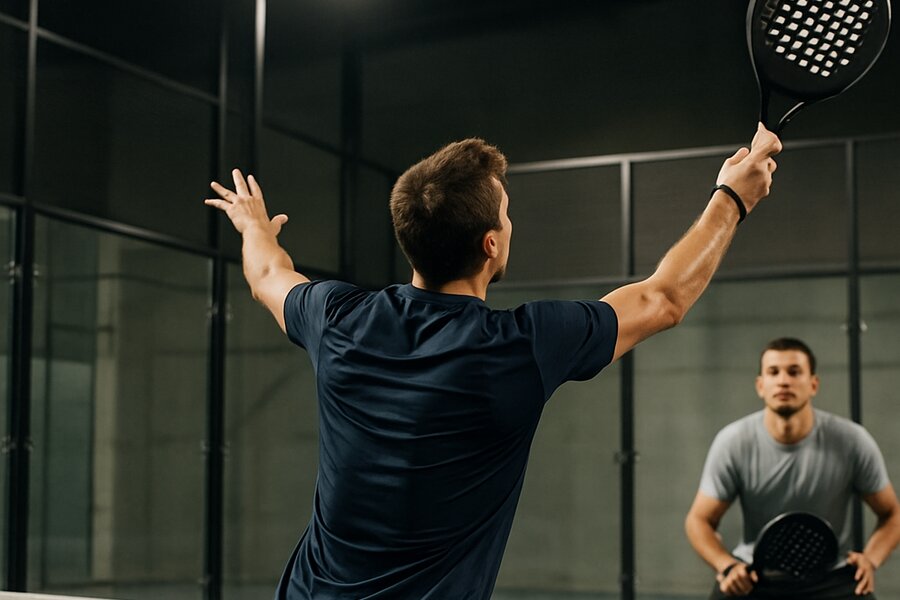
Padel is a sport where the spectacular shots get the attention. The víbora, the bandeja, the winning smash — these are the shots that appear in highlights, that players practise first, and that attract the most discussion. But experienced padel players will tell you something that surprises most beginners: the shots that win the most points in the long run are the ones you never see in a highlights reel.
The lob and the chiquita are padel's most important defensive-to-offensive transition tools. Both are conceptually simple. Both are biomechanically demanding. And both are dramatically underused by developing players who have not yet understood the fundamental tactical reality that padel's wall play creates: in padel, a ball that your opponent cannot attack is more valuable than a ball you cannot quite convert. Control the tempo, neutralise the attack, and wait for the right moment — that is the padel that the best players play.
The Lob: Padel's Most Tactically Important Shot
The lob in padel is not what it is in tennis. In tennis, the lob is a desperation shot — a defensive response when you are dragged out of position, hoping to buy time or occasionally catch an opponent out. In padel, the lob is a primary tactical weapon, used constantly, by every level of player, to reset the point, change the momentum, and most importantly — to displace the opponents from the net.
The reason the lob is so powerful in padel is the back glass. When you hit a good lob over the heads of the net players — high enough to land deep and bounce into the back glass — the net players must turn, retreat, and deal with a ball coming off the glass from behind them. This is one of the most difficult situations in padel, and a consistently accurate lob forces opponents to give up net position regularly. Once you can use the lob reliably, your game changes fundamentally: you are no longer simply defending at the baseline, you are playing a tactical game of position and pressure.
Lob Biomechanics
The padel lob is hit with an open racket face — the face of the racket angled back from vertical so that the ball is launched upward rather than driven forward. The more open the face, the higher the ball travels and the shorter it lands. The degree of face openness is the primary control variable and the main source of difficulty: too open and the ball sails out the back; too closed and the ball does not clear the net players' reach.
The swing path is low to high — starting below the ball and sweeping upward through contact to generate the height needed to clear net players and travel deep into the opponents' half. The racket should be below the ball at the start of the swing, and the contact should be made with the face open and the swing path continuing upward through and after contact.
Body position is important. The lob from a defensive position — when you are pushed back, under pressure, barely reaching the ball — requires you to bend low, get the racket under the ball, and generate upward drive from your legs. The leg bend is not optional: without getting low enough to find the ball below the contact point, the swing path cannot be sufficiently low-to-high to generate the height needed.
The timing of the lob is different from a groundstroke. Because you want height rather than pace, you take the ball slightly later than for a drive — allowing it to drop a little lower, which gives you more room to hit upward through it. Players who try to lob a ball that is still rising produce a flat shot that does not clear the net players; waiting for the ball to drop to a comfortable low position allows the open-face, low-to-high motion to generate the height you need.
The Two Types of Lob
The defensive lob is hit under pressure — when you are stretched wide, when the ball is at your feet, when an aggressive volley has forced you into a difficult position. The goal is simply height and depth: get the ball high enough and deep enough that the opponents cannot attack it comfortably, giving you and your partner time to recover position. Perfect direction is secondary to height and depth.
The offensive lob is hit when you have time — from a ball that sits up at mid-height, from a position in the court where you have options. The goal is precision: placing the lob to land in the specific corner of the court that is furthest from both opponents, ideally bouncing into the back glass at a height and angle that forces a difficult back-glass smash. The offensive lob is not a desperate shot; it is a deliberate tactical choice to attack the net team's overhead under controlled conditions.
When to Lob
Lob when the net players are moving forward aggressively. Lob when your drive is blocked. Lob when you and your partner are both at the baseline and your opponents are at the net — the lob is the correct tactical choice to challenge their net position, not the defensive drive. Lob when your opponents are anticipating a drive and moving to one side — a lob in the opposite direction exploits their movement.
The most common tactical error is not lobbing enough. Players who drive every ball from the baseline are easy to play against at the net: the net players simply move in, volley aggressively, and maintain their position indefinitely. The lob is the mechanism that disrupts this pattern, and players who do not lob consistently give away the tactical battle before the point has begun.
Common Lob Faults
Not getting low enough — trying to lob from an upright position produces a flat drive, not a lob. Not opening the racket face sufficiently — producing a ball that does not clear the net players' reach. Lobbing too shallow — giving the net players an attackable overhead instead of forcing a back-glass retrieval. And lobbing with too much pace — a fast lob that goes out the back is worse than no lob at all.
The Chiquita: Padel's Most Advanced Defensive Shot
The chiquita is one of padel's most distinctive shots and one of the most misunderstood by players coming from tennis backgrounds. It is classified as a defensive shot, but it is better understood as a defensive-to-offensive transition — a shot that neutralises an aggressive net team by making it almost impossible for them to volley effectively.
The chiquita is a sliced or sidespin ball played cross-court, aimed to land at the feet of the opponents at the net. A well-hit chiquita drops sharply after crossing the net, forcing the net players to volley from below the tape — the hardest possible volley situation. It is the shot that padel's best defenders use to turn defence into attack: instead of simply surviving the net team's pressure, the chiquita actively creates a difficult situation for them.
Chiquita Biomechanics
The chiquita is played with an open or semi-open racket face and a sidespin or slice motion. The contact point is low — at knee height or below — which is why the shot is technically demanding: getting down low enough to play a controlled, directed shot from below your knees requires both flexibility and the correct body mechanics.
The stance for a chiquita is wide and low — significantly lower than for a regular groundstroke, with the outside knee dropping close to the floor for a wide ball. The racket comes across and slightly under the ball, with the face slightly open, generating a combination of slice and cross-court direction. The follow-through is short and controlled, finishing with the racket directed toward the target — across the body and upward.
The sidespin component is what makes the chiquita so effective. The ball arrives at the net players' feet with a lateral movement that complicates their volley further: not only is the ball very low, but it is also moving sideways as it falls. This combination of low bounce and lateral movement produces a ball that the most accomplished net players will occasionally mis-volley and that intermediate players find extremely difficult to deal with consistently.
When to Use the Chiquita
The chiquita is most effective when: the opponents are at the net and moving forward aggressively; you are under moderate (not extreme) pressure — enough time to set up the shot but under enough pressure that a drive would be returned aggressively; and you want to change the tempo and keep the ball in play without giving the net team an easy volley. It is particularly effective when the net team has been anticipating a lob and has shifted their weight backward — the chiquita catches them moving in the wrong direction.
The chiquita is an advanced shot. Beginners should focus on the lob, the drive, and the serve before developing the chiquita. But for players who have the basics under control and want to add a genuine tactical weapon to their baseline game, the chiquita is the most impactful shot they can develop.
Common Chiquita Faults
Not getting low enough is the most common fault — playing the chiquita from a ball above knee height produces a flat, easily attacked shot rather than the dipping, foot-level ball that makes the shot effective. The second most common fault is hitting the net — a consequence of not opening the racket face enough on a low contact point. The third is directing the ball too centrally — a chiquita aimed at the net player's body gives them a clean volley; a chiquita aimed at their feet and angled away from them is a much harder problem to solve.
Training the Lob and Chiquita with AI
Both the lob and chiquita are shots where feel and timing are very difficult to self-assess. You know when a lob has gone out — the ball hitting the back fence is the obvious feedback — but you often do not know why. Was the racket face too closed? Was the swing path too flat? Was the contact point too high? These distinctions are invisible without biomechanical data.
OnCourtAI analyses both shots, tracking the critical variables for each: for the lob, racket face angle, swing path angle, and contact timing; for the chiquita, contact height, face angle, sidespin generation, and follow-through direction. The AI identifies which specific element of each shot is producing the pattern you are experiencing — whether it is the lob that will not land deep or the chiquita that is going into the net — and gives you targeted coaching to fix it.
Both shots are available in the OnCourtAI padel analysis alongside the full 9-stroke padel stroke set. Upload a session focused on your defensive game and discover what the AI sees in your lob and chiquita mechanics.